
At 6:30 a.m., staff cannot sign in to the student information system. The district's technology lead is investigating suspicious account activity. The service provider has acknowledged a ticket, but there is no confirmed restoration time. Buses will soon be moving.
This is a constructed exercise scenario, not a reported district incident. Its purpose is to put a practical question in front of the right people: what can the district safely continue, who makes that decision, and what information do they need before the first bell?
The answer is not simply whether IT can restore a server. Attendance, family communications, and other school-day functions may depend on different systems, people, and fallback procedures. A district needs to know which dependencies matter before an outage makes them urgent.
CISA already gives districts a starting point
CISA's K-12 Cybersecurity Foundations: Implementation Guide, p. 34, calls for a written incident response plan with roles, responsibilities, leadership approval, and a physical copy available when the network is inaccessible. On p. 35, it recommends realistic exercises, documented lessons, revisions, and retesting, and points districts to existing tabletop resources.
We do not need another checklist that repeats those instructions. The useful next step is applying them to one district dependency, with the people who own the operational decisions in the room.
Keep the first exercise small
Set aside 45 minutes. Choose one dependency, such as access to the student information system, and one decision period, such as preparing to open school. Invite the district decision-maker or delegate, IT, the relevant operational or data owner, communications, and the existing managed service provider. Include other roles when the chosen scenario needs them.
Bring the current response plan, an approved contact list, a simple dependency sketch, and the provider's escalation arrangements. Use fictional names and records in exercise materials. This is a discussion exercise; nobody should disable a live account, interrupt a school system, or run a recovery operation to make the scenario feel more realistic.
On a narrow screen, scroll the agenda sideways to see what to record.
| Time | Discussion | Record |
|---|---|---|
| First 5 minutes | Confirm the affected function and what is known. | Facts, assumptions, and unanswered questions. |
| Next 10 minutes | Identify what can continue and what requires a fallback. | Operational dependencies and decision authority. |
| Next 15 minutes | Work through escalation, communications, and a delayed provider response. | Decisions, information requests, and alternate contacts. |
| Next 10 minutes | Identify the most consequential gap. | A correction, its owner, and the evidence needed. |
| Final 5 minutes | Agree the follow-up. | A due date and a specific retest. |
Ask for a decision, not a reassuring answer
Start with what the outage prevents. Which tasks require current, verified information? Which have an approved offline procedure? Who can authorize a change to normal operations, and who acts if that person is unavailable? The exercise should use the district's own safety requirements and authority structure; a generic scenario cannot supply those decisions.
Then introduce one complication: the usual district messaging channel is also unavailable. Ask how staff and families would receive an approved update, who checks its accuracy, and where the alternate contact information resides. Do not treat a list stored behind the same unavailable login as an independent fallback.
Give the provider a defined part in the conversation. Who can open an urgent case? Who can authorize recovery work? What can the provider restore under the actual agreement, and what remains the district's responsibility? CISA explicitly advises districts to clarify the backup and restore capabilities included in cloud subscriptions in Practice 3.1, p. 30.
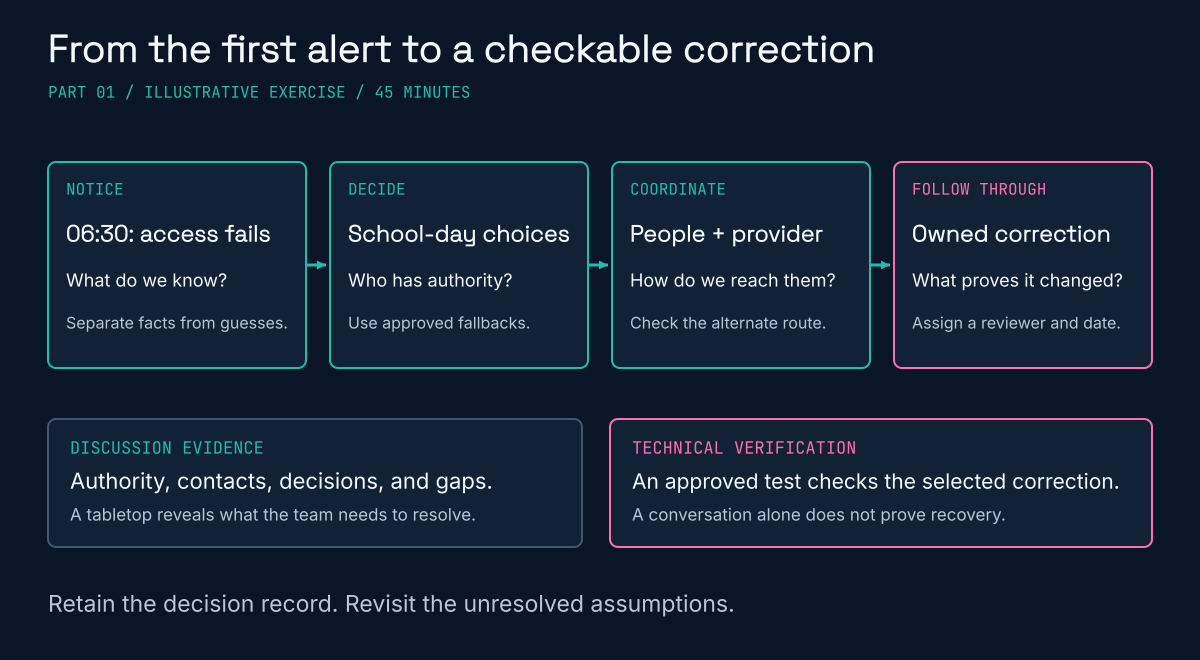
Before the first bell
- Notice the outage and separate facts from guesses.
- Decide who can authorize approved fallbacks.
- Coordinate with staff and the service provider through an alternate route.
- Follow through with a correction owner, reviewer, and date.
Record discussion evidence. Arrange separate, authorized technical verification for recovery claims.
Make one correction checkable
A useful exercise ends with more than an attendance sheet. Write down the decision, the missing information, the person responsible for correcting the gap, and how the district will check the correction. Keep the record short enough that someone will use it.
For example, if the alternate communications route cannot be described, assign an owner to document it and arrange a separately authorized test with designated participants. The follow-up should record whether the message reached the intended contacts and who acknowledged it.
Other gaps need different evidence. An unclear provider obligation may require written clarification. A stale contact list needs an owner and an update process. A claim that the system can be restored needs a technical recovery test.
A tabletop is not a restore test
Talking through recovery can reveal missing authority, contacts, or dependencies. It cannot demonstrate that a backup is complete, that an application will run, or that users can resume work. CISA makes that distinction practical: p. 31 asks leaders to review backup and recovery evidence; p. 32 calls for recurring restoration and validity tests and warns against assumptions about recovery capability.
Schedule technical work separately, with the system owner and provider, under an approved scope. Record what was restored, what was validated, and what remains untested. A successful conversation and a successful restoration answer different questions.
Connect the exercise to the next decision
The value of an exercise depends on what changes afterward. Our approach brings exercise planning and governance together. Rehearse a decision, record a gap, assign responsibility, review evidence, and revisit the decision. The district and its existing provider remain central.
The first engagement does not need to cover every school or system. Talk with Nick about scoping one district exercise with your existing service provider. Start with one dependency and agree how you will verify the follow-up.