Detection engineering Check Point / VPN
Check Point VPN RCE: what did the session reach?
A vulnerable gateway needs a fix. A suspicious session needs an investigation. For an industrial operator, the important next question is which engineering, management, or control-system paths that session could reach.
We logged CVE-2026-85102 in our internal threat watch on September 23, following Check Point's September 22 exploitation report. It remained on our watch list; we had not published a dedicated article. An October 7 GitHub repository claiming a proof of concept brought it back for closer review.
The vulnerability and the need to act predate that repository. The useful work now is to confirm the affected configuration, verify protection on each gateway or cluster member, and investigate what earlier suspicious sessions reached. Patching closes the vulnerability; it does not explain activity that occurred before the fix.
- Fixes releasedVendor disclosure and patch availability.
- Attempts observedCheck Point reports activity against Spark customers.
- Added to KEVCISA's listed remediation due date was September 25.
- New repositoryA claimed PoC, not independent exploit validation.
Timeline sources: Check Point, CISA KEV, and GitHub repository metadata. The KEV deadline applies to agencies covered by the relevant federal requirements; it is not a universal deadline for every operator.
What the October 7 repository establishes
GitHub records the creation of aduli198/CVE-2026-85102 on October 7. Its description mentions RCE, while the README describes an authentication-bypass and VPN-tunnel workflow. We reviewed metadata and documentation, not executable source, and did not run it. This is a new public claim, not an independently validated RCE demonstration. Repository activity alone does not establish a rise in exploitation, and we have not established that it is the first public PoC.
Check what the gateway allows, not just the tunnel you use.
The vulnerable boundary is certificate validation during VPN negotiation. The public vendor description establishes the code-execution risk; it does not provide a complete exploit sequence to reconstruct here. A certificate subject is a hunting clue, not an explanation of the entire flaw. Check Point CNA record.
01 / Site-to-site
Uses or allows certificates?
Include DAIP and LSV communities. The vendor's PSK-only exception is specifically framed around site-to-site communities; do not use it to clear a separate Remote Access configuration.
02 / Remote access
Review it separately.
The advisory includes Remote Access VPN. Its certificate-based Mobile Access hunt is an investigation lead, not a blanket exclusion for every other remote-access setup.
03 / Platform and build
Check each deployment.
Security Gateway and both centrally and locally managed Spark are in scope. R82.20 is listed as unaffected by this CVE, not by every Check Point vulnerability.
Configuration source: Check Point sk1000117, last modified September 24, reviewed October 7.
For an OT site, map the actual dependency: vendor VPN, engineering access, jump host, or remote-site tunnel. Record the permitted destinations and the independent controls between them. Compromise of the gateway threatens the boundary it enforces; it does not establish that every downstream boundary or controller has also been compromised.
A login record is a starting point.
Check Point directs defenders to review anomalous certificate-based Mobile Access logins and investigate subsequent internal scanning. Its published certificate subjects include the following; the list is not exhaustive. Vendor hunting guidance.
CN=vpn,OU=users,O=globalCN=vpn-user,OU=users,O=globalCN=vpnuser,OU=users,O=global
The vendor supplies this starting query for SmartConsole or Spark Management:
product: "Mobile Access" AND action: "Log In" AND "Certificate"Query: sk1000117. Start with the reported activity window, then expand to the actual exposure period and retained history. A matching name is a lead to investigate, not proof that the session was unauthorized.
| Collect, where available | Question it helps answer | Useful next check |
|---|---|---|
| Certificate, user, client, and login result | What identity did the gateway record, and did it accept access? | Compare with authorized users, expected certificates, and approved maintenance. |
| Session ID, time, and assigned VPN address | Which connection belongs to that login? | Resolve address assignment and NAT. An address alone is not an identity. |
| Internal flows and destination records | What did the session try to reach, and what answered? | Compare connection patterns with the permitted engineering or vendor workflow. |
| Decoy interactions and administrative changes | Did it touch a synthetic resource or change access? | Correlate with endpoint, policy, account, and configuration records. |
Preserve source records, clock context, retention gaps, and the configuration in force. Export useful evidence to an approved collector separate from the gateway. Coordinate collection with containment; do not leave a dangerous access path open simply to complete a perfect record.
A familiar account name is not proof of approved access. The destination and the action matter.
Give the next scan something useful to reveal.
A synthetic management service on an approved VPN-reachable segment can turn unexpected discovery into a concrete investigation lead. The placement question is specific: which resource should a legitimate vendor session have no reason to use?
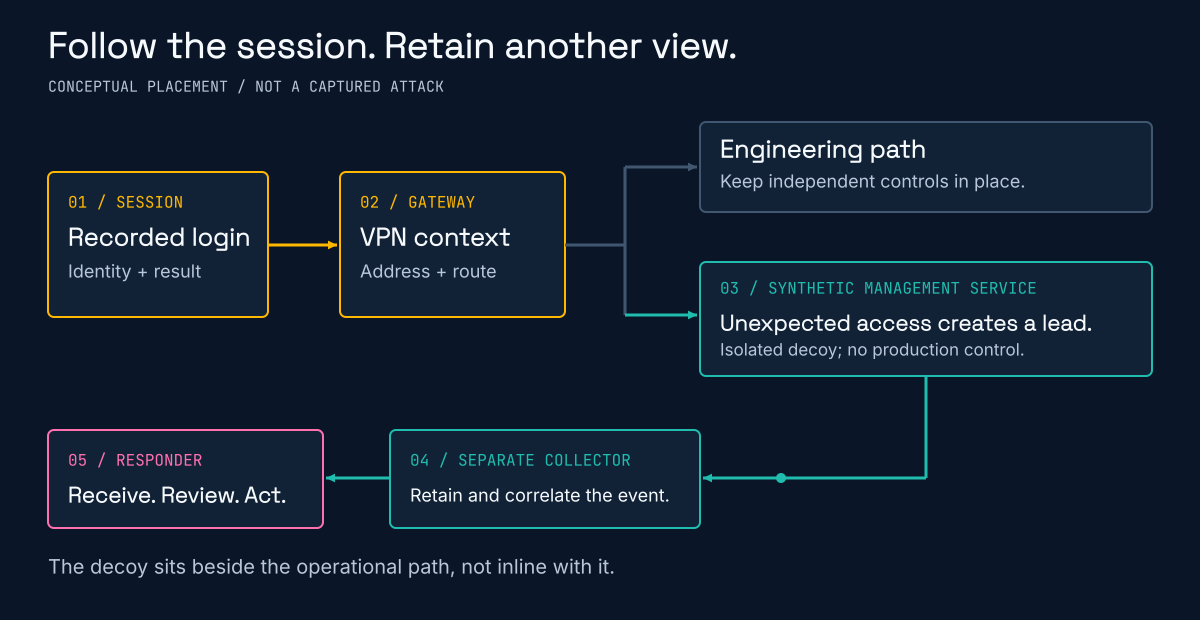
Conceptual detection placement
- Session to VPN gateway: correlate login and assigned address.
- Approved routes: engineering path and a separate synthetic management service.
- Unexpected decoy interaction: retain the event and session context.
- Independent collector to responder: deliver and acknowledge the alert.
The decoy sits beside the operational path, not inline with it.
This does not require reproducing Check Point's vulnerable certificate handler. The decoy observes access to its own service; the gateway and other telemetry explain how that access arrived. We do not claim first-party capture of this CVE or validated Check Point certificate-handshake coverage in our fleet.
- Choose one access path. Define expected visitors and a synthetic service with no production credentials or control function. Do not widen production access to make the test work.
- Commission with a harmless interaction. From an authorized test session, touch only the decoy. Record what it captures and how the session can be correlated.
- Follow the event to a person. Verify collector receipt, alert routing, retained detail, and responder acknowledgement in the team's existing workflow.
- Check failure behavior. Confirm what happens if the gateway, collector, or connection disappears. Evidence survives only where it was actually received and retained.
Our goal is to make an unexpected move easier to investigate, with an alert that reaches someone who can act. The Buying Time, Power Edition field notes develop the separate evidence-retention question.
Verify protection. Keep recovery as a separate decision.
Use the current vendor guidance for the exact product and upgrade path. The CNA record lists R82.10 through Jumbo Take 43, R82 through Take 125, and R81.20 through Take 165 as affected. The following are the corresponding fix thresholds, with other platform options from the support advisory.
| Platform or branch | Vendor-listed option |
|---|---|
| R82.10 / R82 / R81.20 | Matching LivePatch Take 26 package; verify active protection. |
| R82.10 | Jumbo Hotfix Take 44 or later |
| R82 | Jumbo Hotfix Take 126 or later |
| R81.20 | Jumbo Hotfix Take 166 or later |
| R81.10, end of support | Jumbo Hotfix Take 190 listed; plan migration to a supported release. |
| Spark R82.00.10 | Build 2325 or later |
| Spark R81.10.17 | Build 4968 or later |
Sources: sk1000117 and the CNA record. Older R80-family, R81, and R81.10 releases also require attention. NHS England advises moving end-of-life deployments to a supported version.
- Verify the installed and active state. The vendor specifies
cpinfo -y CPupdatesandcplp listfor gateway or ClusterXL LivePatch checks; scalable-platform validation usesg_all cplp list. Follow the platform-specific expected output in sk1000117, including its earlier-offline-package warning. - Use mitigation as a controlled change. For site-to-site VPN, NCSC-NL relays the vendor's interim peer-specific UDP 500/4500 rules and implied-rule change. Remote Access needs its own service rules. These options do not apply to locally managed Spark. Follow the full advisory and test connectivity; a generic two-port block is not the whole procedure.
- Do not confuse patching with clearance. If access was unauthorized, or the exposure cannot be bounded, engage incident response. Determine the need for isolation, rebuild, session termination, and credential or key replacement from the evidence and vendor guidance. Avoid indiscriminate certificate rotation that could disrupt interdependent sites.
- Review the management plane separately. CVE-2026-93616 affects Security Management and has a different fix path. A gateway hotfix does not close that issue. Management advisory.