
3,348 SSH sessions repeated the same eight-input pattern. Check the graphics hardware. Ask about the CPU. Identify the hosting organization. Inspect the GPUs. Then turn to miner names.
That pattern accounted for 80.5% of the 4,161 sessions in our October 6 and 7 compute-appraisal dataset. In a separate session, GPU checks gave way to attempted miner removal in about 37 seconds.
Meet the Prospector, our Deception Check Bestiary character for cryptomining operators and compute hunters. Your compute is the claim. The visitor wants to know what it offers, and sometimes whether someone else has already staked it.
An appraisal in eight moves
The repeated sequence begins with PCI hardware inspection, checking VGA and 3D devices. It asks for the CPU model, then queries an external IP-information service for the hosting organization. NVIDIA product checks follow, then a Radeon check. The final input contains a loop fragment naming familiar miners.

A single GPU query could be routine administration. The ordered sequence tells a richer story: what hardware is available, where it is hosted, and whether the environment may already involve mining.
This gives defenders a behavioral fingerprint they can follow across changing addresses. Repetition makes the pattern useful for grouping activity; it does not require treating every matching visitor as the same operator.
Replay A The appraisal routine
Follow the repeated hardware and hosting survey through its miner-name references.
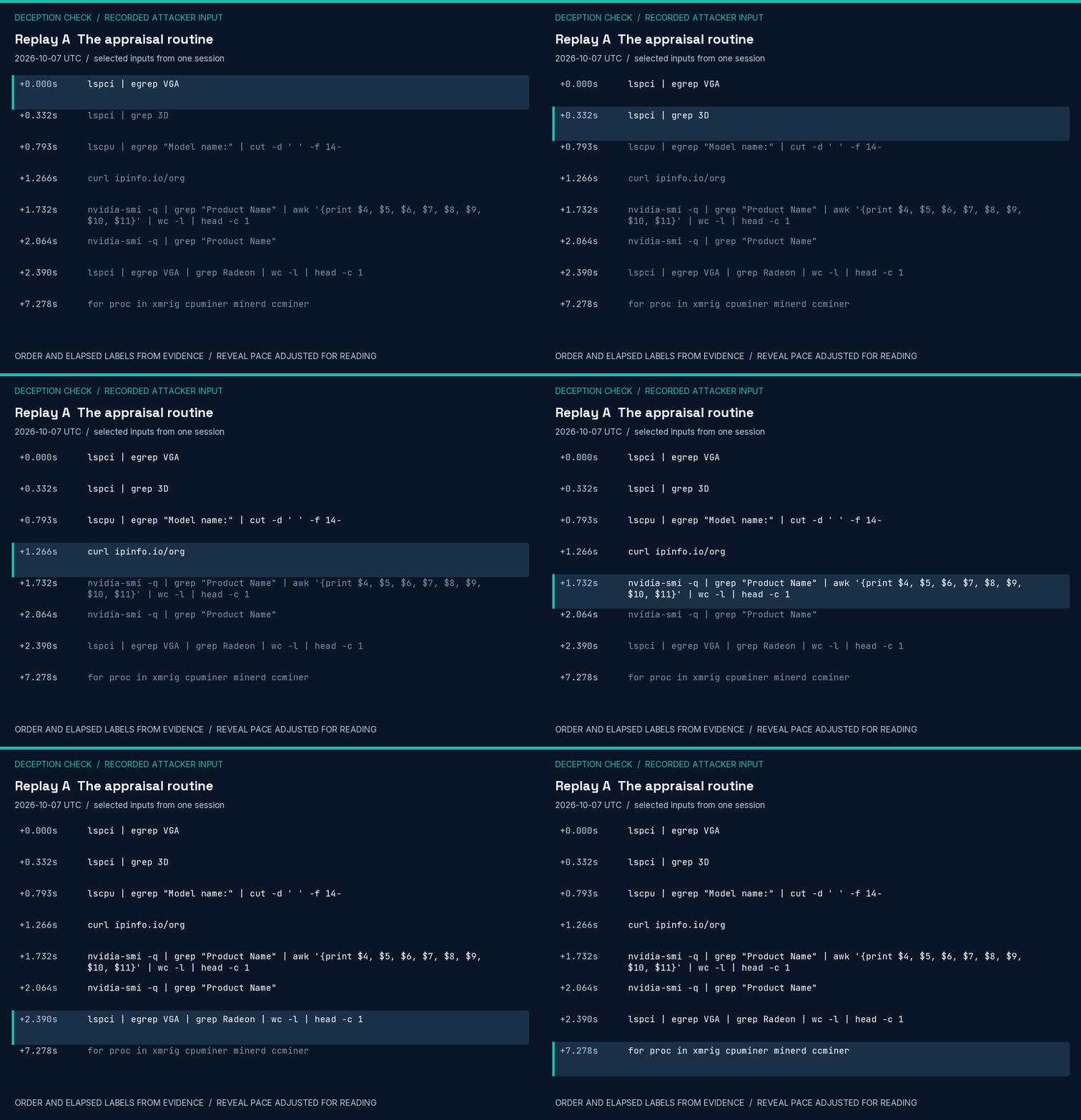
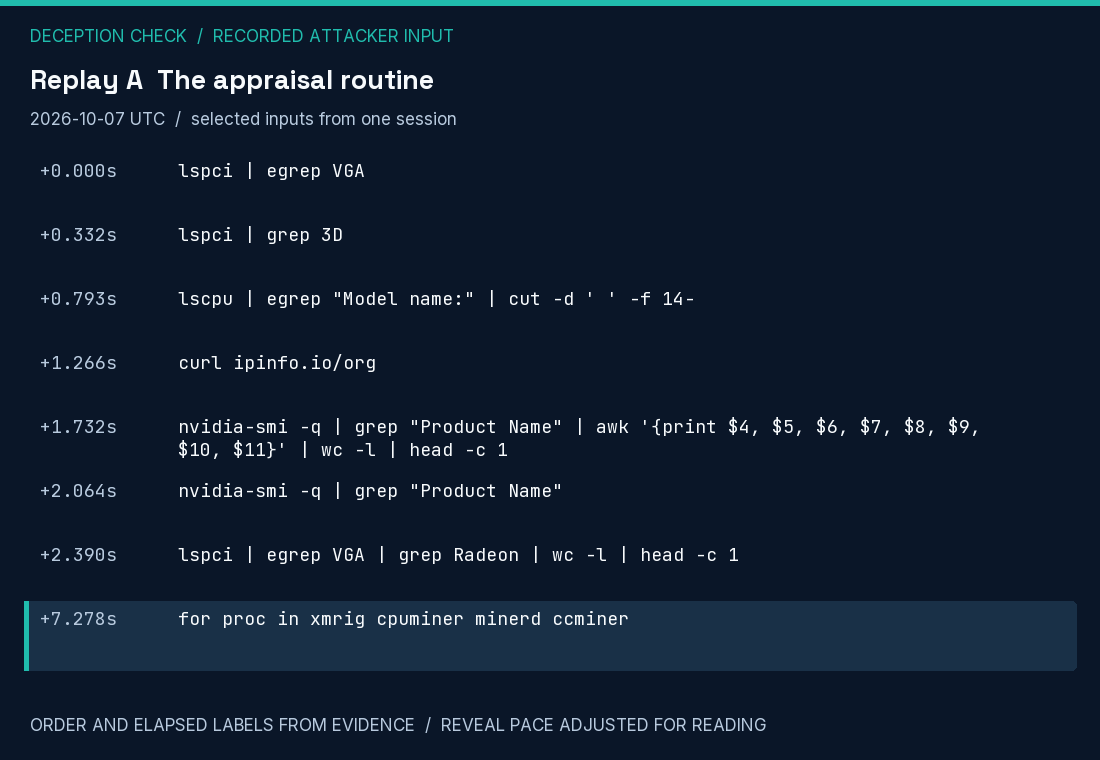
lspci | egrep VGAVGA device inspectionlspci | grep 3D3D device inspectionlscpu | egrep "Model name:" | cut -d ' ' -f 14-CPU model querycurl ipinfo.io/orgExternal hosting-organization lookupnvidia-smi -q | grep "Product Name" | awk '{print $4, $5, $6, $7, $8, $9, $10, $11}' | wc -l | head -c 1Count NVIDIA product-name resultsnvidia-smi -q | grep "Product Name"List NVIDIA product nameslspci | egrep VGA | grep Radeon | wc -l | head -c 1Count Radeon matchesfor proc in xmrig cpuminer minerd ccminerLoop fragment only; body not in exportRead this replay as text
Recorded submitted inputs, not proof of execution. Elapsed times are original.
- Graphics discovery
lspci | egrep VGAVGA device inspection - Graphics discovery
lspci | grep 3D3D device inspection - CPU discovery
lscpu | egrep "Model name:" | cut -d ' ' -f 14-CPU model query - Hosting context
curl ipinfo.io/orgExternal hosting-organization lookup - Graphics discovery
nvidia-smi -q | grep "Product Name" | awk '{print $4, $5, $6, $7, $8, $9, $10, $11}' | wc -l | head -c 1Count NVIDIA product-name results - Graphics discovery
nvidia-smi -q | grep "Product Name"List NVIDIA product names - Graphics discovery
lspci | egrep VGA | grep Radeon | wc -l | head -c 1Count Radeon matches - Miner-name references
for proc in xmrig cpuminer minerd ccminerLoop fragment only; body not in export
Watch the order of the questions in this representative session. The final miner-name fragment ends before a loop body, so the replay stops where the evidence stops.
This was not our first sighting of compute hunting. Summaries of our log archives show mining and appraisal activity back to July, with approximately 860,000 matching command records across the surveyed archives. That is the broader backdrop; the eight-input finding comes from the focused October dataset.
Claim jumping after the survey
In another October 7 session, the visitor checks graphics devices and NVIDIA product names. About 37 seconds after the first GPU check, it submits file-removal commands naming xmrig, .diicot, .black, and Opera, followed by two attempts to terminate XMRig processes.
Replay B From GPU checks to attempted cleanup
A different session moves from graphics discovery to file removal and XMRig termination attempts.
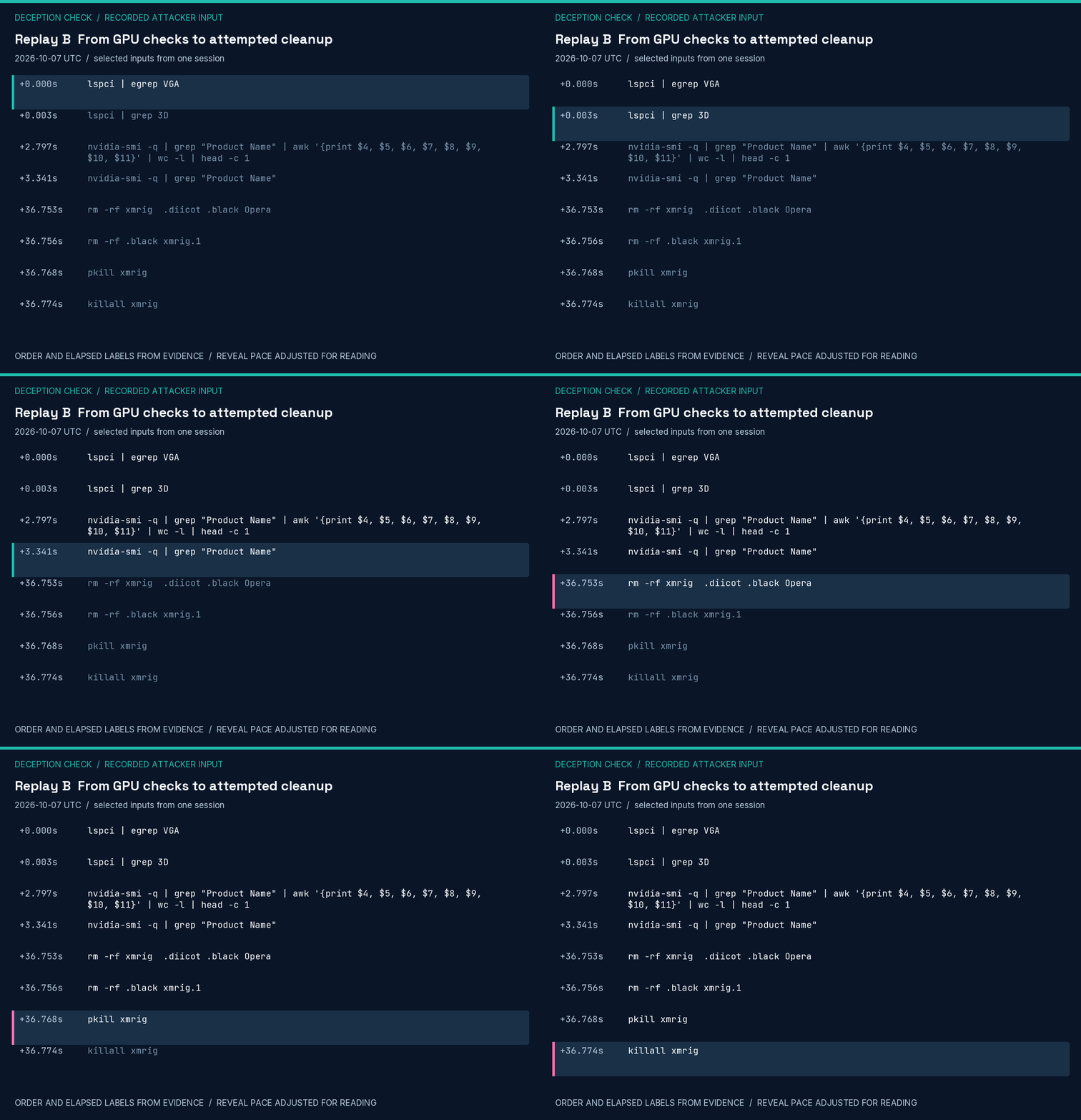
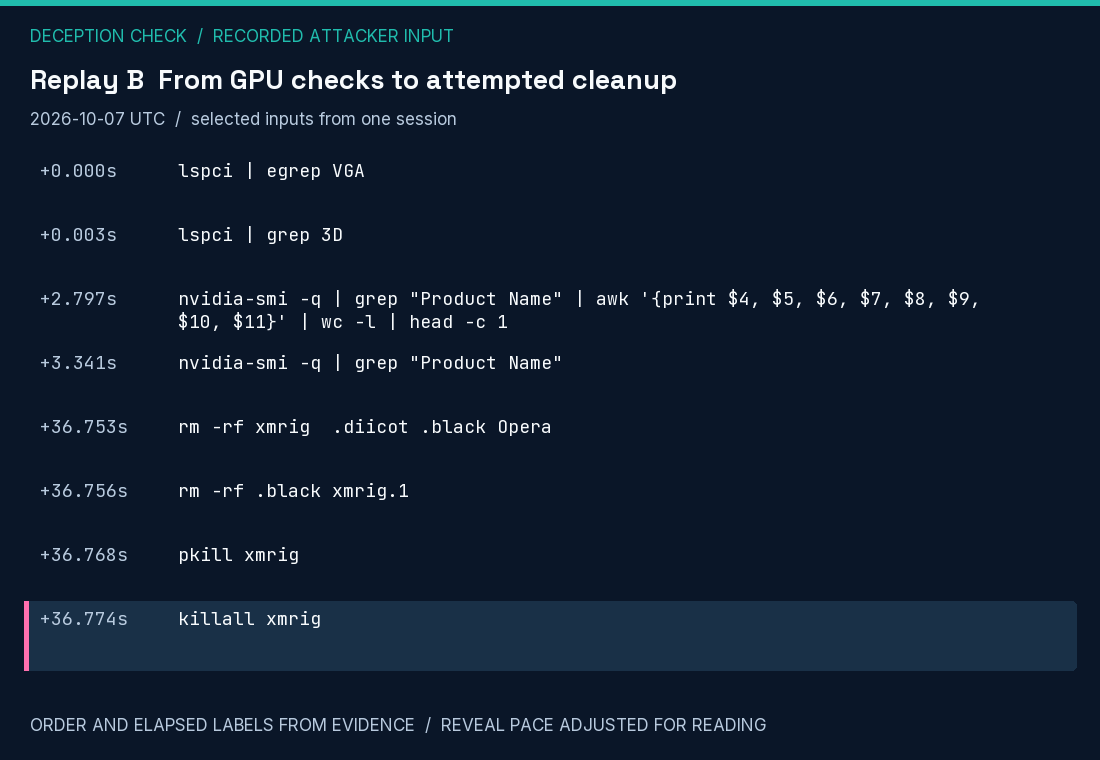
lspci | egrep VGAVGA device inspectionlspci | grep 3D3D device inspectionnvidia-smi -q | grep "Product Name" | awk '{print $4, $5, $6, $7, $8, $9, $10, $11}' | wc -l | head -c 1Count NVIDIA product-name resultsnvidia-smi -q | grep "Product Name"List NVIDIA product namesrm -rf xmrig .diicot .black OperaRemove miner-associated filesrm -rf .black xmrig.1Additional miner-associated file removalpkill xmrigAttempt to terminate XMRig processeskillall xmrigSecond termination commandRead this replay as text
Recorded submitted inputs, not proof of execution. Elapsed times are original.
- Graphics discovery
lspci | egrep VGAVGA device inspection - Graphics discovery
lspci | grep 3D3D device inspection - Graphics discovery
nvidia-smi -q | grep "Product Name" | awk '{print $4, $5, $6, $7, $8, $9, $10, $11}' | wc -l | head -c 1Count NVIDIA product-name results - Graphics discovery
nvidia-smi -q | grep "Product Name"List NVIDIA product names - Attempted cleanup
rm -rf xmrig .diicot .black OperaRemove miner-associated files - Attempted cleanup
rm -rf .black xmrig.1Additional miner-associated file removal - Attempted cleanup
pkill xmrigAttempt to terminate XMRig processes - Attempted cleanup
killall xmrigSecond termination command
The activity has shifted from appraisal to attempted interference. Those commands could clear a rival installation or clean up an earlier deployment of the same tooling. Either way, the transition gives an analyst something more useful than a generic discovery alert.
On a production system, unexpected cleanup can threaten workloads and remove evidence of an earlier compromise. The immediate question becomes: what did this session attempt, what actually happened, and how did it gain access?
A recognizable trail
Darktrace's Diicot research describes SSH compromise followed by hardware and hosting discovery, preparation for mining, and removal of prior compromise artifacts. Its execution chain includes .diicot and Opera.
A public sandbox report submitted in February 2026 provides a closer match: its process trace contains the same multi-name file cleanup and XMRig termination commands seen in our October session, with only whitespace variation in one command.
That makes Diicot-associated tooling a useful comparison for the cleanup case. It does not identify the operator behind the larger appraisal wave. A SOC can hunt the behavior now without waiting for that attribution question to be settled.
Map the behavior before naming the outcome

Hardware enumeration maps to System Information Discovery, T1082. Shell inputs map to attempted Unix Shell activity, T1059.004. Resource Hijacking, T1496 is the downstream concern: an unauthorized workload consuming someone else's compute.
The decoys preserve submitted commands. Production telemetry must establish whether those commands executed and whether a workload followed. This distinction keeps a useful early warning from becoming an unsupported claim of successful mining.
Hunt the transition
For Linux systems, GPU workers, and AI infrastructure, start with an unexpected remote session that combines hardware inspection with an external hosting lookup. Join the access event to the destination host, account, process tree, and time; then follow what happens next.
Prioritize miner termination, file removal, new persistence, unusual outbound connections, and workload changes. Preserve the full command line, parent process, working directory, timestamps, and action results. Approved GPU-health agents and provisioning scripts belong in precise exceptions, not a blanket suppression of GPU utilities.
If cleanup or an unauthorized workload is present, preserve evidence before removing artifacts. Determine the access path and check credential exposure and persistence. Killing a miner does not close the entry point.
You can also test the early warning safely. Run benign inventory commands on an authorized test host and check whether the SOC reconstructs their order. Exercise destructive-cleanup detections with synthetic telemetry or in an isolated lab. The replays here display recorded evidence; they never execute the commands.
See the survey before the workload
Deception creates a place where an unfamiliar visitor has no legitimate business reason to inventory the machinery. That makes the survey itself useful, before a defender has a miner binary or an expensive workload to investigate.
The Prospector gives this behavior a memorable face. Our goal is to turn its recognizable sequence into a detection your team can test and a record your responders can use.
Watch what an unfamiliar session measures, and what it tries to remove afterward.
Research notes
The focused dataset covers October 6 and 7, 2026, UTC: 31,055 selected command records, grouped by decoy and session ID and ordered by timestamp, with identical exported rows checked. The repeated pattern occurs in 3,348 of 4,161 such groups. Historical archive summaries use broader mining/appraisal matching; their approximately 860,000 records are not repetitions of this sequence or a count of attacks. The replays are different sessions, with recorded elapsed times and reveal pacing adjusted for reading. Records preserve submitted input rather than verified operating-system execution. Source addresses, decoy names, credentials, and internal identifiers are omitted.