Detection engineering NetScaler / HTTP
NetScaler request smuggling: when the gateway and backend disagree.
A security gateway can record one version of a request while the service behind it processes another. The useful question is whether your evidence can explain the difference.
CVE-2026-88773 is an HTTP request-smuggling vulnerability in NetScaler ADC and Gateway. Citrix rates it CVSS v4.0 9.3 and identifies HTTP or SSL load-balancing, content-switching, VPN, or authentication virtual servers as the relevant configuration. It was disclosed in the September 27 bulletin alongside the exploited RCEs, CVE-2026-88771 and CVE-2026-88772. Vendor bulletin.
The response cannot stop at another list of CVEs. Our goal is to help a responder distinguish what reached the edge, what was forwarded, and what the application actually did. Those are three different observations.
One byte stream. Two boundaries.
An HTTP intermediary and the server behind it each decide where a request ends. Request smuggling exploits a disagreement in those decisions. Bytes treated as part of one message by one parser can be interpreted differently by the next. The important boundary is in the protocol, not the box drawn on the network diagram.
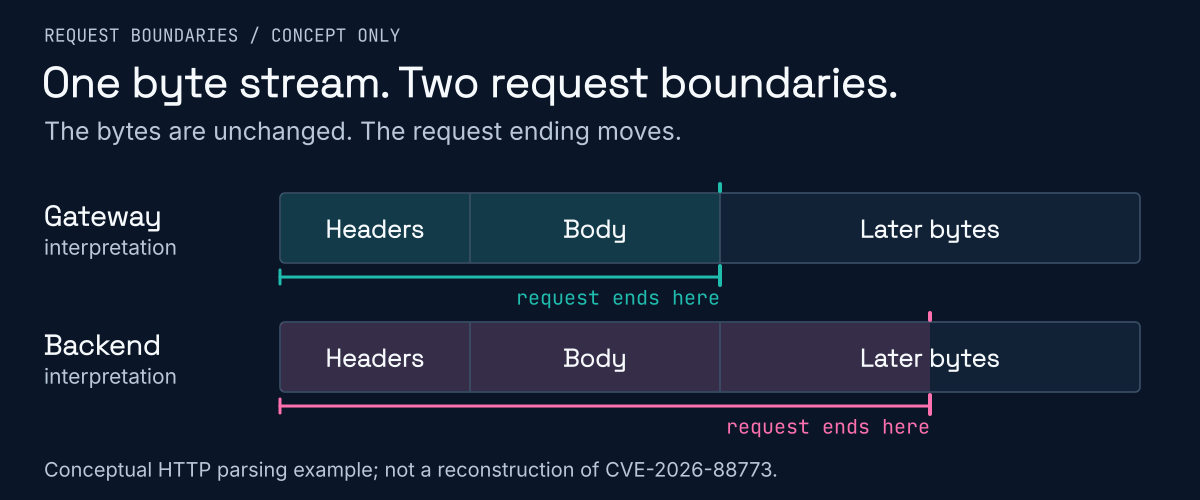
Same bytes, different decisions
Gateway interpretation
Request 1 endsLater bytes: another request
Backend interpretation
Request 1 continues into those later bytes
A conceptual parsing disagreement, not a reconstruction of CVE-2026-88773.
Conflicting Content-Length and Transfer-Encoding headers are a familiar example, but they are not the definition of this CVE. Chunk-size parsing can also matter. HTTP/1.1 explicitly requires implementations to prevent integer-conversion overflow when handling potentially large chunk sizes. RFC 9112, section 7.1.
What the new public research claims
The Scyrix-LLC repository presents a reverse-engineering write-up alleging a 32-bit chunk-size wrap in NetScaler's HTTP parser, with behavior depending on the backend parser. That is a researcher claim, not a Citrix-confirmed mechanism or a result reproduced by Deception Check. Citrix identifies request smuggling but does not disclose that implementation detail in its bulletin. We have not executed the supplied examples. Read the research claim.
A generic smuggling explanation does not establish that this CVE bypasses every WAF rule, defeats authentication in every deployment, or executes commands. The defensible detection lesson is narrower and more useful: one component's clean-looking request record may not describe the full exchange.
Keep the evidence that can answer the question.
A difference in log counts is a starting point, not a verdict. Connection reuse, health checks, retries, and requests served without contacting the backend can all complicate a comparison. Start by documenting the expected path and what each collection point retains.
What arrived?
Entry point, timestamp, connection context, protocol, and the recorded request fields.
Check whether framing and rejected input are retained.
What changed?
Selected backend, connection reuse, policy decision, and any protocol conversion or normalization.
Document the intermediary's transformations.
What was processed?
Backend request records, application actions, response behavior, and relevant errors.
Correlate by more than a shared source address.
These are collection requirements to verify, not fields every NetScaler log automatically contains. A decoded request record may omit the original chunk framing. A packet capture of encrypted traffic cannot answer a plaintext parsing question by itself. Select a lawful, approved collection point where the relevant representation is available, and protect any credentials or personal data it could contain.
| Artifact | Useful for | Check before relying on it |
|---|---|---|
| Gateway access and policy records | Reconstructing the edge's view and routing decisions. | Which headers, rejects, and connection identifiers survive collection? |
| Backend and application records | Showing which requests and actions the service recorded. | Can an action be linked to the correct forwarded exchange? |
| Approved raw traffic capture | Examining framing at the selected capture point. | Is it plaintext, complete, and collected before the relevant normalization? |
| Decoy interaction record | Showing unexpected access to a synthetic service. | Does it preserve the required detail, or only a parsed summary? |
Preserve the build, configuration, clock context, and collection settings with the records. Without that context, a clean test on one architecture can become an unsupported assurance about another.
A decoy can expose the next move.
There are two useful designs here, with different evidence.
Detection deployment
Put a synthetic target on the path.
An approved decoy behind a gateway or along an engineering-access route can create a distinct signal when someone reaches it. Record the interaction and route it to the existing response team.
Evidence of unexpected access; investigate the route used.
Controlled research
Measure both parser views.
An isolated test environment with representative gateway and backend builds, paired capture, and controlled requests can examine parsing behavior.
Evidence about that tested configuration, not every deployment.
A decoy hit alone does not identify the vulnerability used to reach it. A generic HTTP persona also does not reproduce a proprietary gateway's parser. We are not presenting first-party capture of CVE-2026-88773 here. The opportunity is to make suspicious access observable and preserve the context needed to investigate it.
For utilities and industrial operators, start with the actual dependency: a vendor connection, an engineering jump path, or an application supporting operations. NetScaler is edge infrastructure, not a controller vulnerability. Its operational significance comes from what it protects and can reach.
- Agree the question. Which synthetic service should trigger review if accessed through this route?
- Generate an approved interaction. Use a harmless commissioning request, not an exploit against a production gateway.
- Follow the record. Confirm the gateway, decoy or backend, collector, and responder provide enough context to reconstruct the path.
- Record the limits. State what this test demonstrated, what was not retained, and who will investigate a future signal.
Patch the current risk, then verify the rest.
For CVE-2026-88773, the September bulletin lists fixes in 14.1-73.37, 13.1-64.23, 14.1-FIPS 14.1-73.37, and 13.1-FIPS/NDcPP 13.1-37.279. Those are historical fix thresholds, not a reason to stop at an older build. CTX697096.
| Branch | CTX697174 release or later in that branch |
|---|---|
| 14.1 ADC / Gateway | 14.1-73.41 |
| 13.1 ADC / Gateway | 13.1-64.28 |
| 14.1-FIPS ADC | 14.1-73.41 FIPS |
| 13.1-FIPS / NDcPP ADC | 13.1-37.282 |
CVE-2026-88779 is a memory-overflow denial-of-service issue in SAML SP or IdP configurations. Confirm applicability and the supported upgrade path against the current Citrix advisory; the table does not establish that an appliance is free of every vulnerability.
- Keep the configuration task. The earlier CVE-2026-88778 TCP issue also calls for the documented Enhanced ISN Generation change. “One upgrade closes all eight” is incomplete.
- Separate exploitation status. CISA's October 4 catalog lists 88771, 88772, and 88779, but not 88773. A public research write-up is not evidence of in-the-wild exploitation. KEV source.
- Preserve and investigate. If compromise is suspected, follow Citrix's response procedure for evidence collection, isolation, credential and key handling, and rebuilding. Coordinate collection with exposure reduction.
Our earlier NetScaler warning-to-response article covers the decision process when a warning arrives before complete technical guidance. This follow-up adds the evidence question: can your team explain what crossed the boundary?