
PHP2Shell probes: follow the destination beyond PHP
Deception Check Research · October 23, 2026 · All times UTC
The download address in a PHP-tagged request was already in our HTTP traversal, SSH, and telnet logs. The source of that request had submitted SSH delivery commands the previous evening. That is the useful connection in our PHP2Shell research: one web alert can give you a much wider hunt.
Start with the submitted destination, 217[.]60[.]102[.]5/sh, and the request source, 77[.]90[.]185[.]20. Search them as different roles across your web, SSH, and egress records, then check what the real service did next. Our decoys record what was sent; execution needs evidence from the actual service.
PHP2Shell refers to two PHP flaws: CVE-2026-109618 concerns corruption during out-of-memory handling; CVE-2026-109619 concerns stale state carried between requests handled by the same worker. An upload-progress marker alone does not establish either mechanism. PHP advisories.
The retained selection contains 26 unique requests from five source IPs between October 21 at 08:42:42 and October 22 at 21:55:25: 23 scanner/reconnaissance requests carrying PHP2Shell tool labels, one downloader input carrying a php2shell argument, and two separate WordPress inclusion attempts. Keeping that last pair separate matters: an upload-progress field is not a fingerprint for the new PHP flaws.
What we observed
Swipe tables to see all columns.
| Observed category | Requests | What it supports |
|---|---|---|
| Self-labelled multipart probes | 18 | Deliberate PHP2Shell-related probing |
| Self-labelled probes, body unavailable | 3 | Request-path and tool-label evidence |
| Self-labelled GET reconnaissance | 2 | A tool identifying itself with PHP2Shell |
| Extensive VC upload/session-file inclusion attempts | 2 | Separate WordPress plugin technique; not PHP2Shell |
php2shell-tagged downloader input |
1 | Session-file inclusion attempt with an attacker-supplied vector label |
The event index preserves all 26 records, their selection rules, timestamps, and revised classifications. The WordPress pair remains available for comparison, not folded into a PHP2Shell exploit count.
26 SELECTED REQUESTS / THREE DISTINCT CLASSES
Before which disclosure?
21 OCTOBER / UTC
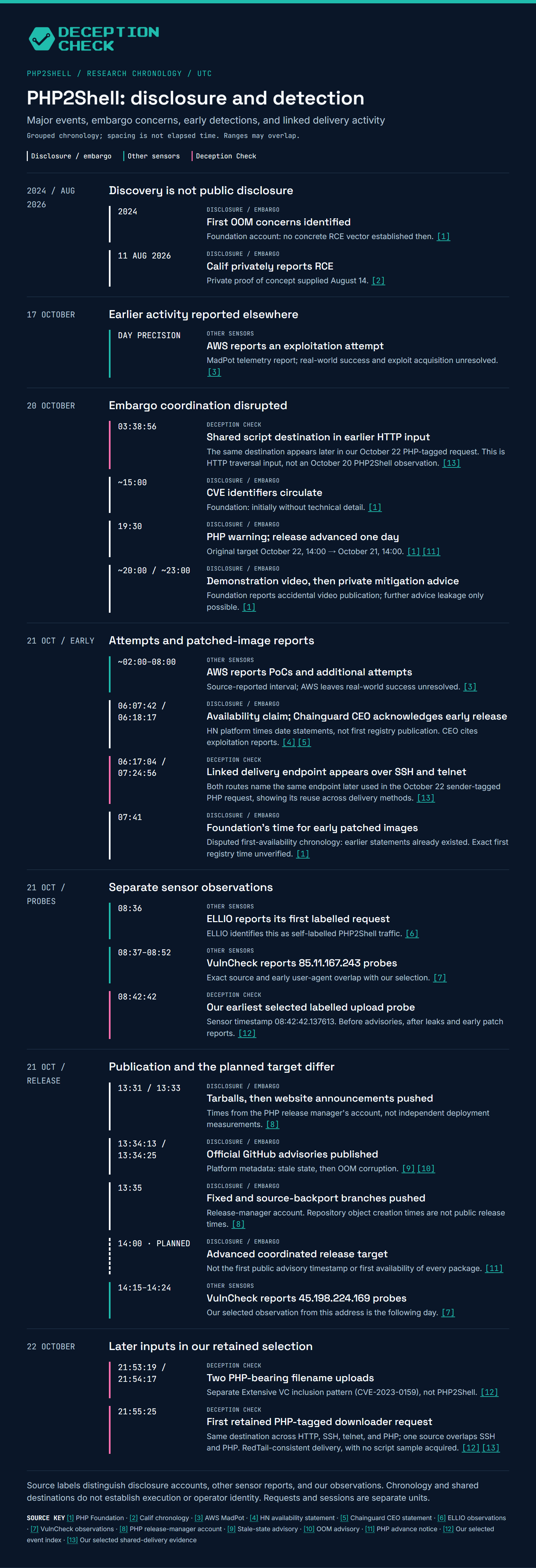
Our first selected probe arrived at 08:42:42 on October 21, about 4 hours 51 minutes before GitHub published PHP's two advisories at 13:34:13 and 13:34:25. It also preceded the scheduled 14:00 release. That is early relative to the advisories, but vulnerability information was already public.
The PHP Foundation describes circulating CVE identifiers and an accidental demonstration video on October 20, followed by an accelerated release. The full timeline carries the wider disclosure and distributor chronology, including differing accounts of early package availability. PHP Foundation account.
Other defenders also saw pre-advisory activity. AWS describes an October 17 attempt and further activity from around 02:00 on October 21. ELLIO reports its first labelled request at 08:36. VulnCheck's 08:37 to 08:52 observations include 85[.]11[.]167[.]243, the same address as our 08:42:42 probe. AWS MadPot, ELLIO, VulnCheck.
RESEARCH WORKBENCH
The full timeline, in one place
Follow discovery, private reporting, public disclosure, and sensor observations together. Each event retains its own source and time precision. This is an ordered ledger, not an elapsed-time chart or a claim that one event caused another.
Showing all 27 events.
- 2024 (exact date unspecified)UTC where timed
Discovery and disclosure
First signs of the OOM problem found
Theoretical exploitation concern then, not a demonstrated RCE vector left knowingly unfixed.
Source · year, Foundation account · discovery account
- 2026-08-11UTC where timed
Discovery and disclosure
Calif reports initial RCE
Private vulnerability reporting, not public exploit publication.
Source · day, researcher account · third-party account
- 2026-08-14UTC where timed
Discovery and disclosure
Calif supplies private RCE proof of concept
PHP confirmation reported August 15.
Source · day, researcher account · third-party account
- 2026-10-17UTC where timed
Other sensor reports
AWS reports an exploitation attempt
AWS leaves real-world success and exploit acquisition unclear.
Source · day, AWS telemetry report · third-party telemetry
- 2026-10-20 03:38:56.597539UTC where timed
Our observations
Shared script destination in earlier HTTP input
HTTP traversal input names the same destination later submitted in our October 22 sender-tagged PHP request. The connection is the destination, not evidence of PHP2Shell use on October 20.
Source · microsecond string, sensor-recorded · first-party shared-delivery observation
- 2026-10-20 ~15:00UTC where timed
Discovery and disclosure
CVE identifiers circulate
Initial leak described as nontechnical.
Source · approximate, Foundation account · disclosure account
- 2026-10-20 19:30UTC where timed
Discovery and disclosure
PHP warning; release advanced by one day
New target October 21, 14:00; original October 22, 14:00.
Source · minute, Foundation account · disclosure account
- 2026-10-20 ~20:00UTC where timed
Discovery and disclosure
Accidental demonstration video
Limited technical details; copies reportedly circulated.
Source · approximate, Foundation account · disclosure account
- 2026-10-20 ~23:00UTC where timed
Discovery and disclosure
Mitigation guidance shared privately
Possible further leakage, not established.
Source · approximate, Foundation account · disclosure account
- 2026-10-21 ~02:00 to 08:00UTC where timed
Other sensor reports
AWS reports PoCs and more attempts
None of its six published source IPs matches our selected five.
Source · approximate, AWS account · third-party telemetry
- 2026-10-21 06:07:42UTC where timed
Discovery and disclosure
Public comment reports patched-image availability
Dates the statement, not first registry publication or image contents.
Source · second, HN platform metadata · timestamped statement
- 2026-10-21 06:17:04.639046UTC where timed
Our observations
Linked delivery endpoint appears over SSH
This SSH input names the same endpoint later used in the October 22 sender-tagged PHP request. The time marks the first retained vector-bearing curl fragment; the preceding host-bearing SCP fragment is 06:17:04.630082. Across the selected evidence window: 21 loader sessions from 2 sources, not 21 proven executions.
Source · microsecond string, sensor-recorded · first-party shared-delivery observation
- 2026-10-21 06:18:17UTC where timed
Discovery and disclosure
Chainguard CEO acknowledges early release
Cites exploitation reports; underlying evidence not supplied there.
Source · second, HN platform metadata · first-party statement
- 2026-10-21 07:24:56.429853UTC where timed
Our observations
Linked delivery endpoint appears over telnet
This telnet input names the same endpoint later used in the October 22 sender-tagged PHP request, extending the linked activity across delivery methods. Across the selected evidence window: 16 loader sessions from 15 sources. Parser-split input is not proof of execution. HTTP requests and SSH/telnet sessions are different units and must not be summed as attacks or infections.
Source · microsecond string, sensor-recorded · first-party shared-delivery observation
- 2026-10-21 07:41UTC where timed
Discovery and disclosure
Foundation's time for early Chainguard images
Earlier statements predate this. First registry publication remains unverified.
Source · minute, Foundation account · disputed first-availability chronology
- 2026-10-21 08:36UTC where timed
Other sensor reports
ELLIO reports its first labelled request
Self-labelled PHP2Shell request. No exact source-IP overlap with our selected cohort established here.
Source · minute, ELLIO telemetry report · third-party telemetry
- 2026-10-21 08:37 to 08:52UTC where timed
Other sensor reports
VulnCheck sees 85.11.167.243 probes
Exact source and early user-agent overlap with our selection.
Source · minute, VulnCheck telemetry report · third-party telemetry
- 2026-10-21 08:42:42.137613UTC where timed
Our observations
Our first selected labelled upload probe
85.11.167.243; body retained as capture placeholder, not exploit validation.
Source · microsecond string, sensor-recorded · first-party observation
- 2026-10-21 13:31UTC where timed
Discovery and disclosure
Public release tarballs pushed
Push chronology attributed to Daniel Scherzer; activity views not independently retrieved.
Source · minute, release-manager account · release-manager account
- 2026-10-21 13:33UTC where timed
Discovery and disclosure
Website announcement repository pushed
Not an exact independent measurement of php.net deployment.
Source · minute, release-manager account · release-manager account
- 2026-10-21 13:34:13UTC where timed
Discovery and disclosure
Stale-state advisory published
4h51m30.862387s after our first selected request.
Source · second, GitHub published_at · platform publication metadata
- 2026-10-21 13:34:25UTC where timed
Discovery and disclosure
OOM advisory published
4h51m42.862387s after our first selected request.
Source · second, GitHub published_at · platform publication metadata
- 2026-10-21 13:35UTC where timed
Discovery and disclosure
Fixed and backport branches pushed
Git object author/tag dates are not first-publication evidence.
Source · minute, release-manager account · release-manager account
- 2026-10-21 14:00UTC where timed
Discovery and disclosure
Advanced coordinated release target
Do not substitute this deadline for exact advisory or package publication.
Source · scheduled deadline · planned event
- 2026-10-21 14:15 to 14:24UTC where timed
Other sensor reports
VulnCheck sees 45.198.224.169 probes
Our selected request from this address is the next day, not this same event.
Source · minute, VulnCheck account · third-party telemetry
- 2026-10-22 21:53:19.178708 and 21:54:17.455252UTC where timed
Our observations
Our two filename-injection uploads
Separate Extensive VC inclusion pattern using options[template], documented as CVE-2023-0159. Not PHP2Shell.
Source · sensor-recorded · first-party observation
- 2026-10-22 21:55:25.787307UTC where timed
Our observations
First retained PHP-tagged downloader request
Same delivery host/path as earlier HTTP, SSH, and telnet inputs. Source 77.90.185.20 also appears in SSH. This dates our retained observation, not the first adoption of the vector. The delivery pattern is RedTail-consistent; the script was not retrieved.
Source · sensor-recorded · first-party observation
How the later request connects to wider delivery activity
OBSERVED INPUTS / SHARED DESTINATION
217[.]60[.]102[.]5/shNamed in submitted commandsAt 21:55:25 on October 22, a request from 77.90.185.20 placed PHP code in an upload-progress field. If executed, it would fetch hxxps://217[.]60[.]102[.]5/sh with wget or curl, then pipe the result to a Unix shell with a php2shell argument. A following request referenced a session-file path associated with the submitted session identifier.
That is a session-file inclusion attempt. php2shell is the sender's label passed to the shell invocation, not our validation of a PHP2Shell exploit. The shared destination and earlier SSH input remain useful regardless of that label.
The broader retained logs contain other inputs requesting the same HTTPS host and /sh path, with apache, ssh, or telnet arguments. Those arguments are visible in the submitted commands; we have not inspected how the remote script uses them.
Swipe tables to see all columns.
| Delivery route | Retained evidence | Source addresses |
|---|---|---|
| Apache-style HTTP traversal | 104 distinct requests | 47 |
| SSH | 21 delivery sessions | 2 |
| Telnet | 16 delivery sessions | 15 |
php2shell-tagged session-file attempt |
1 request | 1 |
Requests and sessions are different counting units. The PHP request is already included in the 26-request selection; the table is a separate view of shared delivery activity, not an additional attack total. Counts and method.
The HTTP delivery pattern appears in our retained evidence by 03:38:56 on October 20. There is a second connection beyond the destination: 77.90.185.20 submitted the SSH route at 21:25:51 on October 21, then the PHP route the following evening. That combination makes this a useful cross-protocol hunt.
All 104 HTTP traversal requests use libredtail-http; the PHP downloader request has no user agent. Published SANS observations and Akamai's sample-based RedTail research describe comparable traversal, downloader, and multi-exploit delivery patterns. Our assessment is RedTail-consistent delivery, not confirmed malware-family identification: we did not fetch the remote script or obtain an installed sample. SANS observations, Akamai's RedTail analysis.
URLhaus also records an October 4 malware-download URL on the same destination address at /clean. That is historical context for the host, not validation of our /sh path. URLhaus record.
What the captured uploads tell us
Padding is part of the request, not a malware file
The earliest requests used php2shell-scan/109618, targeted /index.php, and declared 62,935-byte bodies. The retained body fields contain capture placeholders. Associated capture records identify uploads named a and b.
Static inspection of three retained copies of each file reproduced their logged hashes and established their complete contents:
Swipe tables to see all columns.
| File | Bytes | Complete retained content |
|---|---|---|
a |
10,370 | CRLF, then 5,184 A bytes and 5,184 B bytes |
b |
64 | 64 C bytes |
VulnCheck describes the same a/b upload pattern as an attempt to cause memory exhaustion, and reports that its observed requests did not exhaust memory in a single request. Our retained files are padding, consistent with that interpretation. For an OOM investigation, multipart structure, allocation behavior, and worker errors matter more than finding executable content inside each upload. The byte-analysis record contains the offsets and hashes; use them for artifact correlation. VulnCheck's observations.
Those files do not reconstruct the full multipart request. Three later records retain only 4,096 characters of declared 62,929-byte bodies; three other labelled probes retain no body. That capture gap matters when assessing the conditions required to trigger either PHP vulnerability.
A separate WordPress technique caught by the same selection
Two October 22 uploads from 45.115.26.26 placed PHP in an uploaded filename, while the visible file content was Z. The code prints EXTVC_OK and attempts to pass a query-string value to system().
The following requests use extensive_vc_init_shortcode_pagination and options[template], matching the Extensive VC Addons local-file inclusion pattern documented for CVE-2023-0159. The upload-progress field supplies a session-file poisoning technique; it does not make this PHP2Shell. They also put c=id in POST data while the injected code reads $_GET['c'], an observable mismatch. The replay retains that distinction. WPScan advisory, Exploit-DB 52085.
RESEARCH WORKBENCH
Walk through the retained evidence
These walkthroughs reconstruct the logs, not exploitation on a real PHP server. Playback uses one record every four seconds, not the original timing; no code or network request is executed. All steps are also written out below each replay.
Request received
Incoming method, path, source, and retained input.
Artifact inspected
Retained bytes checked against recorded hashes.
Response recorded
Status and generation metadata describe the decoy.
Runtime evidence needed
Actual worker, process, file, and egress records.
Padding files: investigate the request and worker
All three retained copies of each artifact match. These repetitive bytes are padding. In an OOM investigation, inspect multipart structure and worker memory behavior; these files alone do not reconstruct the full request.
a · 10,370 bytesb · 64 bytesExact sequence, not a shared length scale. File a starts with CRLF; its two large runs are equal in length. File b is shown on its own track.
Separate Extensive VC filename injection and inclusion attempts
Sanitized reconstruction from retained records.
Step 1 of 4
Upload request
POST /wp-login.php; multipart filename contains PHP that prints EXTVC_OK and reads a command from the GET parameter c. Session identifier redacted.
Recorded HTTP 200; response_length 1913; generated response flag true.
No verified PHP execution or session-file write.
Full sequence transcript
POST /wp-login.php; multipart filename contains PHP that prints EXTVC_OK and reads a command from the GET parameter c. Session identifier redacted.
Recorded HTTP 200; response_length 1913; generated response flag true.
No verified PHP execution or session-file write.
POST /wp-admin/admin-ajax.php; form field options[template]=/tmp/sess_[redacted]; c=id is in the POST body; logged query is empty.
Recorded HTTP 404; response_length 1259; generated response flag true.
No verified session-file inclusion or command execution.
POST /wp-admin/admin-ajax.php; form field options[template]=/var/lib/php/sessions/sess_[redacted]; c=id is in the POST body; logged query is empty.
Recorded HTTP 404; response_length 923; generated response flag true.
No verified session-file inclusion or command execution.
POST /wp-admin/admin-ajax.php; form field options[template]=/var/lib/php/session/sess_[redacted]; c=id is in the POST body; logged query is empty.
Recorded HTTP 404; response_length 1259; generated response flag true.
No verified session-file inclusion or command execution. The submitted filename reads GET c, while these requests place c in POST.
Retained evidence, October 22, 2026; observed source 45[.]115[.]26[.]26; first of two comparable target sequences
Sender-tagged downloader input and a session-path request
Sanitized reconstruction from retained records.
Step 1 of 2
Upload-progress request
POST /index.php; retained body prefix places PHP inside PHP_SESSION_UPLOAD_PROGRESS. It requests retrieval from hxxps://217[.]60[.]102[.]5/sh and pipes retrieved content to a shell with the argument php2shell. Session identifier redacted.
Recorded HTTP 404; response_length 0; generated response flag true.
No verified PHP execution, outbound retrieval, or shell execution.
Full sequence transcript
POST /index.php; retained body prefix places PHP inside PHP_SESSION_UPLOAD_PROGRESS. It requests retrieval from hxxps://217[.]60[.]102[.]5/sh and pipes retrieved content to a shell with the argument php2shell. Session identifier redacted.
Recorded HTTP 404; response_length 0; generated response flag true.
No verified PHP execution, outbound retrieval, or shell execution.
GET /index.php?page=/tmp/sess_[redacted]; the raw session-path value matches the preceding POST cookie. Cookie and session identifier redacted.
Recorded HTTP 200; response_length 0; generated response flag true.
No verified session-file inclusion or payload result. Two later GETs use different session identifiers and are outside this selected two-step replay.
Retained evidence, October 22, 2026; observed source 77[.]90[.]185[.]20; selected POST and immediately following GET
Read the selection and counting method
Selection and counting method
Selection uses PHP2Shell identifiers or upload-progress markers in incoming request fields, excluding generated responses. Twenty-eight matching rows reduce to 26 unique original request lines after exact-hash deduplication. Eleven contain a source address; 15 use a connection record with the same sensor identity and session. No timing-only or cross-sensor joins are used.
Classify after selecting: 23 tool-labelled probes/reconnaissance requests from three addresses; one php2shell-tagged downloader input from a fourth; and two separate Extensive VC uploads from a fifth. Three labelled requests have no retained bodies and stay separate from the multipart category. The public event index preserves stable IDs and original-line hashes so readers can trace the counts; archive custody and review records are retained privately.
Source joins require the same sensor identity and session. A matching session identifier is not proof that two requests reached the same PHP worker.
26-request event index · Sanitized replay data · Standalone evidence guide
Scanner labels are context, not identity
VulnCheck independently reports two addresses in our selection: 85.11.167.243 and 45.198.224.169. The first overlaps our early probe interval; our request from the second is on the following day.
ELLIO reports Mirai-loader delivery from 45[.]198[.]224[.]169 on October 21. That is useful additional behavior from another sensor network, not a malware-family finding for our later request. Dated ASN, registry, and Shodan context remains alongside the IOC table. ELLIO observations.
Treat user agents the same way. shellflow-php2shell/1.0 appears in a public tool's source, but a copied header does not identify who ran it. Public tool source.
RESEARCH WORKBENCH
Indicators and network context
Use the addresses below to find related records, then follow the activity. The five source addresses and the submitted download destination have different roles. This is an investigation list, not a blanket blocklist.
ASN and location describe provider records, not an operator or an attacker’s location. Country labels explicitly distinguish GeoIP estimates from registry information. Lookup context is dated; it is not a reconstruction of routing at the moment of each request.
Request windows shown to whole seconds in UTC; full stored timestamps are in the event index. On narrow screens, each network row becomes a labelled card.
| Address and observed role | Selected requests / first to last UTC | ASN / network | Location context | Source and interpretation |
|---|---|---|---|---|
85[.]11[.]167[.]243observed request source | 20 | AS197170TechTies Inc.; 85.11.167.0/24 | BulgariaShodan GeoIP | Current AS197170 differs from AS209630 in VulnCheck’s October 21 report. Historical routing remains unresolved.Record dates: ASN/prefix: 2026-10-23; retained Shodan view last seen: 2026-10-21RIPEstat route · RIPEstat ASN · Shodan host data |
185[.]28[.]119[.]18observed request source | 2 | AS62005BlueVPS OU; 185.28.119.0/24 | United StatesShodan GeoIP | Shodan data also carries an open-dir tag, a service observation rather than an intent assessment.Record dates: ASN/prefix: 2026-10-23; retained Shodan view last seen: 2026-10-21RIPEstat route · RIPEstat ASN · Shodan host data |
45[.]198[.]224[.]169observed request source | 1 | AS215925VPSVAULT.HOST LTD; 45.198.224.0/24 | CanadaAFRINIC registration country; GeoIP not verified | Shodan scanner tag; an explicit GeoIP country was not verified.Record dates: 2026-10-23RIPEstat route · RIPEstat ASN · Registry record · Shodan host data |
45[.]115[.]26[.]26observed request source | 2 | AS199457SolidCore Hosting LTD; 45.115.26.0/24 | VietnamAPNIC registration country; GeoIP not verified | APNIC assignment is a /26 inside the currently announced /24. Registry and routing records describe different layers.Record dates: 2026-10-23RIPEstat route · RIPEstat ASN · Registry record |
77[.]90[.]185[.]20observed request source | 1 | AS213790Limited Network LTD; 77.90.185.0/24 | LithuaniaShodan GeoIP | Shodan scanner tag. This source also appears in the retained SSH delivery activity.Record dates: ASN/prefix: 2026-10-23; retained Shodan view last seen: 2026-10-23RIPEstat route · RIPEstat ASN · Shodan host data |
217[.]60[.]102[.]5submitted downloader destination | Not a source count | AS209373SWISSNET LLC; 217.60.102.0/24 | NetherlandsRIPE registration country; GeoIP not verified | Submitted retrieval destination. These records do not establish a callback to it.Record dates: 2026-10-23RIPEstat route · RIPEstat ASN · Registry record |
Tool strings, destination, and captured-file hashes
Swipe or focus the reference tables to scroll horizontally.
| Value | Role | How to use it |
|---|---|---|
hxxps://217[.]60[.]102[.]5/sh | submitted retrieval URL | Do not browse or fetch. /sh bytes not retrieved or analyzed. |
libredtail-http | caller-supplied user agent in 104 distinct HTTP traversal requests | RedTail-consistent published indicator, not a standalone family or operator verdict. The php2shell-tagged downloader input has no user agent. |
150ae88f0999032e2a6113501d6082f54a3ed98d02427b21a96e773a27d7bf16 | byte-verified filler upload-artifact SHA256 | Exact repetitive bytes verified; artifact correlation, not malware classification, operator identity, or PHP2Shell trigger/success proof. |
27d926a6708d6769d97d065e7a5a860ab496eab272c03d1cebc55ec71b954fa2 | byte-verified filler upload-artifact SHA256 | Exact repetitive bytes verified; artifact correlation, not malware classification, operator identity, or PHP2Shell trigger/success proof. |
php2shell-scan/109618 | caller-supplied user agent | Mutable tool label, not ownership or CVE validation. |
php2shell-109618 | caller-supplied user agent | Mutable tool label, not ownership or CVE validation. |
shellflow-php2shell/1.0 | caller-supplied user agent | Mutable tool label, not ownership or CVE validation. |
Additional request markers and contextual strings
These broad strings need surrounding structure and activity. Do not alert on generic field names, paths, or shell-tool names alone.
| Value | Role | How to use it |
|---|---|---|
apache | argument submitted to the shared downloader/shell invocation | Incoming vector label, not a verified infection tag or evidence of executed loader behavior. |
ssh | argument submitted to the shared downloader/shell invocation | Incoming vector label, not a verified infection tag or evidence of executed loader behavior. |
telnet | argument submitted to the shared downloader/shell invocation | Incoming vector label, not a verified infection tag or evidence of executed loader behavior. |
php2shell | argument submitted to the shared downloader/shell invocation | Incoming vector label, not a verified infection tag or evidence of executed loader behavior. |
dlr | remote transfer account name submitted in SSH command text | Attacker-supplied retrieval context only. No credential or key material distributed; no account accessed. |
B7kQpoc618 | selected-request multipart boundary | Correlation marker; easy to copy; not actor identity. |
EXTINJ | selected-request multipart boundary | Correlation marker; easy to copy; not actor identity. |
WebKitFormBoundaryn407ilex | selected-request multipart boundary | Correlation marker; easy to copy; not actor identity. |
EXTVC_OK | output marker present in submitted PHP | Not observed response output or execution proof. |
__START__ | output marker present in submitted PHP | Not observed response output or execution proof. |
__END__ | output marker present in submitted PHP | Not observed response output or execution proof. |
PHP_SESSION_UPLOAD_PROGRESS | contextual input name, filename, or argument | Generic or caller-controlled; not a standalone malicious signature. |
PHPSESSID | contextual input name, filename, or argument | Generic or caller-controlled; not a standalone malicious signature. |
f | contextual input name, filename, or argument | Generic or caller-controlled; not a standalone malicious signature. |
a | contextual input name, filename, or argument | Generic or caller-controlled; not a standalone malicious signature. |
b | contextual input name, filename, or argument | Generic or caller-controlled; not a standalone malicious signature. |
php2shell | contextual input name, filename, or argument | Generic or caller-controlled; not a standalone malicious signature. |
/ | requested path | Path intent, not installed software or successful execution. |
/index.php | requested path | Path intent, not installed software or successful execution. |
/lib/phpunit/phpunit/Util/PHP/eval-stdin.php | requested path | Path intent, not installed software or successful execution. |
/wp-login.php | requested path | Path intent, not installed software or successful execution. |
/wp-admin/admin-post.php | requested path | Path intent, not installed software or successful execution. |
/wp-admin/admin-ajax.php | requested path | Path intent, not installed software or successful execution. |
extensive_vc_init_shortcode_pagination | contextual inclusion/file-read sequence feature | Neighbor records, not necessarily selected-cohort members; no actual file read or inclusion established. |
options[template] | contextual inclusion/file-read sequence feature | Neighbor records, not necessarily selected-cohort members; no actual file read or inclusion established. |
local-download | contextual inclusion/file-read sequence feature | Neighbor records, not necessarily selected-cohort members; no actual file read or inclusion established. |
local-destination-id=0 | contextual inclusion/file-read sequence feature | Neighbor records, not necessarily selected-cohort members; no actual file read or inclusion established. |
../../../wp-config.php | contextual inclusion/file-read sequence feature | Neighbor records, not necessarily selected-cohort members; no actual file read or inclusion established. |
/etc/passwd | contextual inclusion/file-read sequence feature | Neighbor records, not necessarily selected-cohort members; no actual file read or inclusion established. |
c=id | contextual inclusion/file-read sequence feature | Neighbor records, not necessarily selected-cohort members; no actual file read or inclusion established. |
page | contextual inclusion/file-read sequence feature | Neighbor records, not necessarily selected-cohort members; no actual file read or inclusion established. |
/tmp/sess_[redacted] | contextual inclusion/file-read sequence feature | Neighbor records, not necessarily selected-cohort members; no actual file read or inclusion established. |
/var/lib/php/sessions/sess_[redacted] | contextual inclusion/file-read sequence feature | Neighbor records, not necessarily selected-cohort members; no actual file read or inclusion established. |
/var/lib/php/session/sess_[redacted] | contextual inclusion/file-read sequence feature | Neighbor records, not necessarily selected-cohort members; no actual file read or inclusion established. |
system() | function/tool named in incoming payload | Not actual process telemetry. Complete executable payload deliberately omitted. |
$_GET['c'] | function/tool named in incoming payload | Not actual process telemetry. Complete executable payload deliberately omitted. |
wget | function/tool named in incoming payload | Not actual process telemetry. Complete executable payload deliberately omitted. |
curl | function/tool named in incoming payload | Not actual process telemetry. Complete executable payload deliberately omitted. |
sh | function/tool named in incoming payload | Not actual process telemetry. Complete executable payload deliberately omitted. |
Indicator JSON · Plain-text indicators · Dated network-context records
What to do with this evidence
Patch, then verify the running deployment. PHP's first fixed supported-branch releases are 8.2.35, 8.3.36, 8.4.27, and 8.5.12. Supplier backports may use different package versions. Confirm the deployed build and the runtime loaded by workers after restart or replacement; a downloaded package or banner is not enough. PHP advisory, Chainguard package guidance.
October 23 update: PHP separately announced CVE-2026-115560, an unlikely session-upload-progress RCE vector under a specific combination of application code and configuration. PHP suggests setting session.upload_progress.enabled=0 until the next regular bugfix release; applications that never change the session serialize handler at runtime can keep the feature enabled. Follow the new PHP notice as well as updating for the two PHP2Shell flaws.
Follow the request into other telemetry. Start with the role-labelled indicators, then correlate upload structure, PHP-bearing filenames, session-path requests, worker failures, unexpected child processes, file changes, and outbound connections. Search the destination and source across HTTP, SSH, and telnet records where available. For stale-state analysis, establish the actual PHP worker across requests, not just a matching session identifier.
Cover the service you actually run. Include Apache httpd/apache2 when PHP is loaded as a module, not only php-fpm or php-cgi. Hunt the destination in outbound telemetry, libredtail-http in HTTP logs, and downloader/shell command lines in endpoint records. Worker crashes and memory-exhaustion bursts are triage leads to correlate with requests, not stand-alone exploit verdicts. The on-page detection appendix includes these separate paths.
Record what the sensor retained and what it generated. The later web-decoy sequences recorded generated responses. A 200, 404, capture label, or handler counter cannot settle whether a real PHP worker executed code. Keep declared body length, retained prefix length, capture reference, and response provenance as separate fields.
Use the technical evidence guide, event index, and sourced timeline to structure the investigation. The useful next question is not only “did this address hit us?” It is “what did the running service do next?”
RESEARCH WORKBENCH
Research detection appendix
Start with the telemetry you have. Request-pattern rules find the input seen in this investigation; endpoint hunts look for what a real service did next. Neither is a universal exploit detector. Each entry states its prerequisites, tuning needs, and the checks actually performed.
Tool-labelled requests and suspicious upload structure. Encrypted HTTP needs visibility after TLS termination.
PHP worker process ancestry, command lines, network activity, and file changes.
YARA triage of captured request text, not proof that a payload ran or that filler is malware.
YARA compiled and passed inert fixtures. Sigma parsed and passed local predicate checks. Snort and platform queries received static syntax/schema review; their engines and tenants were not exercised. Supplemental local checks cover destination/direction predicates and error text, not platform execution. Download both fixture files and the validator with the rules.
Download the complete detection pack
Deployment and tuning guide · Inert test fixtures · Local validator
yaml
Sigma: PHP2Shell labels in HTTP
Find requests whose caller-supplied User-Agent names PHP2Shell.
Read yaml source
title: PHP2Shell Label in HTTP User Agent
id: 6e9d7efe-1b45-46dd-9b17-3accb7b8654e
status: experimental
description: >-
    Finds caller-supplied PHP2Shell labels, including the three labels in this
    research. A match is a research or probe lead, not a validated exploit,
    malicious operator identity, or evidence of execution.
author: Deception Check
date: '2026-10-23'
references:
    - https://sigmahq.io/docs/basics/log-sources.html
logsource:
    category: webserver
    definition: 'Map cs-user-agent to the parsed incoming HTTP User-Agent value.'
detection:
    selection:
        cs-user-agent|contains: 'php2shell'
    condition: selection
fields:
    - c-ip
    - cs-method
    - cs-uri-query
    - cs-user-agent
falsepositives:
    - Authorized testing, research scanners, copied labels, and log replay
level: low
Download sigma-web-php2shell-label.yml
Documentation: Sigma field taxonomy · Sigma rule specification
yaml
Sigma: Linux PHP worker starts a shell or downloader
Find generic runtime behavior that deserves investigation after a PHP request.
Read yaml source
title: Linux PHP Worker Starts Shell or Downloader
id: 0fc952b5-d91d-492c-93a2-c091588cf23a
status: experimental
description: >-
    Finds a direct shell or downloader child of a php-fpm or php-cgi process.
    This is a generic runtime investigation lead, not a PHP2Shell signature.
    Add verified worker names used in your deployment and baseline expected jobs.
author: Deception Check
date: '2026-10-23'
references:
    - https://sigmahq.io/docs/basics/log-sources.html
logsource:
    category: process_creation
    product: linux
    definition: 'Requires full executable paths for Image and direct ParentImage.'
detection:
    selection_parent:
        ParentImage|re: '/php-(fpm|cgi)([0-9]+([.][0-9]+)*)?$'
    selection_child:
        Image|re: '/(sh|bash|dash|ksh|zsh|curl|wget)$'
    condition: selection_parent and selection_child
fields:
    - Image
    - CommandLine
    - ParentImage
    - ParentCommandLine
    - User
    - ProcessId
    - ParentProcessId
falsepositives:
    - Application features that intentionally invoke shells, downloaders, or maintenance tasks
level: medium
Download sigma-linux-php-worker-child.yml
Documentation: Sigma field taxonomy · Sigma log-source guidance
yara
YARA: offline input triage and exact filler correlation
Triage locally retained text or decoded HTTP requests; keep filler correlation separate from suspicious-input signals.
Read yara source
// Offline files only. Supply one decoded request/body per file where possible.
// Do not use these rules to classify the two filler artifacts as malware.
import "hash"

rule DC_PHP2Shell_Text_Label : research_label low_confidence
{
    meta:
        author = "Deception Check"
        date = "2026-10-23"
        purpose = "Weak text correlation; documentation and copied labels also match"
        scope = "Offline UTF-8/ASCII text, at most 2 MiB; not a CVE or malware signature"
    strings:
        $label = "php2shell" ascii nocase
    condition:
        filesize <= 2MB and $label
}

rule DC_Upload_Progress_PHP_Function_Tokens : input_triage stronger_context
{
    meta:
        author = "Deception Check"
        date = "2026-10-23"
        purpose = "Co-occurring upload-progress, PHP opening tag, and command-function tokens"
        scope = "Stronger than a label alone; no parsing, field binding, execution, or CVE claim"
    strings:
        $progress = "PHP_SESSION_UPLOAD_PROGRESS" ascii
        $php = "<?php" ascii nocase
        $call = /\b(system|shell_exec|passthru)\s*\(/ ascii nocase
    condition:
        filesize <= 2MB and all of them
}

rule DC_Known_Repetitive_Upload_Artifact : filler_correlation not_malware_classification
{
    meta:
        author = "Deception Check"
        date = "2026-10-23"
        purpose = "Exact byte correlation with the two verified repetitive filler uploads"
        scope = "A matching artifact is filler; surrounding request safety remains unresolved"
    condition:
        (filesize == 10370 and hash.sha256(0, filesize) ==
            "150ae88f0999032e2a6113501d6082f54a3ed98d02427b21a96e773a27d7bf16") or
        (filesize == 64 and hash.sha256(0, filesize) ==
            "27d926a6708d6769d97d065e7a5a860ab496eab272c03d1cebc55ec71b954fa2")
}
Download php2shell-offline-triage.yar
Documentation: YARA rule syntax · YARA hash module
snort
Snort 3: visible HTTP labels and body-token combinations
Find a PHP2Shell User-Agent label or a multipart request containing upload-progress/PHP/command-function tokens.
Read snort source
# Snort 3, experimental hunt rules; STATIC REVIEW ONLY, no Snort engine test.
# Local SIDs: check for collisions before loading. Use alert, not automatic drop.
# Inspect plaintext HTTP or an authorized decrypted traffic feed after TLS termination.
# Encrypted HTTPS alone does not expose these HTTP buffers. HTTP inspector depth,
# stream reconstruction, decoding, and multipart retention affect coverage.
# SID 1000618: weak caller-supplied label; not exploit or operator identification.
alert tcp any any -> $HOME_NET any (msg:"DC RESEARCH PHP2Shell label in HTTP user agent"; flow:to_server,established; service:http; http_header:field user-agent; content:"php2shell",nocase; sid:1000618; rev:1;)
# SID 1000619: co-occurrence within multipart request body; not a multipart parser
# or proof that the PHP tokens are the upload-progress field value.
# A source-code upload or training text can match. No code execution is established.
alert tcp any any -> $HOME_NET any (msg:"DC RESEARCH multipart upload-progress with PHP command-function tokens"; flow:to_server,established; service:http; http_header:field content-type; content:"multipart/form-data",nocase; http_client_body; content:"PHP_SESSION_UPLOAD_PROGRESS"; content:"<?php",nocase; pcre:"/\b(system|shell_exec|passthru)\s*\(/i"; sid:1000619; rev:1;)
Download php2shell-snort3.rules
Documentation: Snort service matching · Snort HTTP headers · Snort HTTP body buffers · Snort PCRE syntax
kusto
Microsoft Defender XDR: PHP worker child processes
Translate the runtime hunt to Defender Advanced Hunting.
Read kusto source
// Microsoft Defender XDR Advanced Hunting, not a generic Sentinel table.
// Requires onboarded devices, DeviceInfo, and DeviceProcessEvents telemetry.
// Static schema/logic review only; not compiled or run in a Defender tenant.
// Generic direct-child runtime hunt, not a validated PHP2Shell exploit detector.
let LinuxDevices = DeviceInfo
    | where Timestamp > ago(7d)
    | summarize arg_max(Timestamp, OSPlatform) by DeviceId
    | where OSPlatform == "Linux"
    | project DeviceId;
DeviceProcessEvents
| where Timestamp > ago(7d)
| where DeviceId in (LinuxDevices)
| where ActionType == "ProcessCreated"
| where InitiatingProcessFileName matches regex @"^php-(fpm|cgi)([0-9]+([.][0-9]+)*)?$"
| where FileName in ("sh", "bash", "dash", "ksh", "zsh", "curl", "wget")
| project Timestamp, DeviceId, DeviceName, ReportId, AccountName,
          InitiatingProcessFileName, InitiatingProcessId, InitiatingProcessCommandLine,
          FileName, ProcessId, ProcessCommandLine
| order by Timestamp desc
Download defender-php-worker-child.kql
Documentation: DeviceProcessEvents schema · DeviceInfo schema · Kusto matches regex operator
spl
Splunk CIM: PHP2Shell User-Agent
Translate the HTTP label hunt to Splunk CIM Web data.
Read spl source
tag=web earliest=-7d http_user_agent="*php2shell*"
| table _time src dest http_method url status http_user_agent
Download splunk-web-php2shell-label.spl
Documentation: Splunk CIM Web fields
spl
Splunk CIM: PHP worker child processes
Translate the runtime predicate to CIM Endpoint.Processes fields.
Read spl source
tag=process tag=report earliest=-7d
| where match(parent_process_path,"/php-(fpm|cgi)([0-9]+([.][0-9]+)*)?$")
    AND match(process_path,"/(sh|bash|dash|ksh|zsh|curl|wget)$")
| table _time dest user parent_process_path parent_process_id process_path process_id process
Download splunk-php-worker-child.spl
Documentation: Splunk CIM Endpoint fields
logscale
CrowdStrike Falcon LogScale: PHP worker child processes
Translate the runtime hunt to native Falcon process telemetry.
Read logscale source
// Falcon process telemetry in LogScale/Advanced Event Search.
// Not legacy Splunk-based Falcon Event Search syntax.
// Static schema/logic review only; not compiled or run in a Falcon tenant.
#event_simpleName=ProcessRollup2 event_platform=Lin
| ParentBaseFileName=/^php-(fpm|cgi)([0-9]+([.][0-9]+)*)?$/
| ImageFileName=/\/(sh|bash|dash|ksh|zsh|curl|wget)$/
| table([@timestamp, aid, ComputerName, ParentBaseFileName, ParentProcessId,
         ImageFileName, TargetProcessId, CommandLine], limit=1000)
Download falcon-php-worker-child.logscale
Documentation: Falcon process-query examples · Falcon process fields and event tags
sumo
Sumo Logic: Apache access-log User-Agent
Translate the HTTP label hunt using Sumo's documented Apache access parser.
Read sumo source
_sourceName=*access_log* AND _sourceCategory=*apache*
| parse using public/apache/access
| where user_agent matches /(?i).*php2shell.*/
| fields _messageTime, src_ip, method, url, status_code, user_agent
Download sumo-web-php2shell-label.sumo
Documentation: Sumo Apache access parser · Sumo Apache field extraction · Sumo matches operator
yaml
Sigma: loader pipeline or SCP remote path
Find the vector-bearing curl/wget-to-sh pattern or the SCP remote operand present in retained command text.
Read yaml source
title: Linux Loader Pipeline Or SCP Remote Path With Observed Traits
id: be6d250c-aa01-4b46-8fe3-5fd3e8d2bfb2
status: experimental
description: >-
    Finds command-line text containing curl or wget piped to sh -s with an
    apache, ssh, telnet, or php2shell argument, OR an scp command containing
    the remote operand dlr@HOST:sh. Transfer direction is not established.
    Destinations are deliberately
    unrestricted; correlate with the shared-destination hunt and ancestry.
    This is a text-pattern hunt, not shell parsing or a CVE signature.
author: Deception Check
date: '2026-10-23'
references:
    - https://sigmahq.io/sigma-specification/specification/sigma-rules-specification.html
logsource:
    category: process_creation
    product: linux
    definition: 'Requires the complete process CommandLine, often from the shell -c event.'
detection:
    selection_pipeline:
        CommandLine|re: '(^|[ /"''(;])(?:curl|wget)[ \t]+[^|\r\n]*\|[ \t]*(?:/[^ \t|;]+/)?sh[ \t]+-s[ \t]+(?:--[ \t]+)?(?:apache|ssh|telnet|php2shell)(?:[ \t;&"''()]|$)'
    selection_scp:
        CommandLine|re: '(^|[ /"''(;])scp[ \t]+(?:[^;|&\r\n]*[ \t])?["'']?dlr@[^ \t:;|&"''\r\n]+:sh(?:[ \t"'')]|$)'
    condition: selection_pipeline or selection_scp
fields:
    - Image
    - CommandLine
    - ParentImage
    - ParentCommandLine
    - User
    - ProcessId
    - ParentProcessId
falsepositives:
    - Authorized installation scripts using the same positional arguments
    - Authorized SCP transfers using a remote file named sh and the account dlr
    - Quoted examples, research, test harnesses, and replayed command lines
level: medium
Download sigma-linux-loader-pipe-vector.yml
Documentation: Sigma rule specification
yaml
Sigma: libredtail-http User-Agent
Find the caller-supplied label seen in the linked HTTP traversal requests.
Read yaml source
title: Libredtail HTTP User Agent
id: 8463f0de-92ec-45ee-9a28-1d66593e2259
status: experimental
description: >-
    Finds the caller-supplied libredtail-http label seen in the linked HTTP
    traversal requests. Investigate request paths and surrounding activity.
    A copied label does not establish malware family, operator, or execution.
author: Deception Check
date: '2026-10-23'
references:
    - https://sigmahq.io/sigma-specification/specification/sigma-rules-specification.html
logsource:
    category: webserver
    definition: 'Map cs-user-agent to the parsed incoming HTTP User-Agent value.'
detection:
    selection:
        cs-user-agent|contains: 'libredtail-http'
    condition: selection
fields:
    - c-ip
    - cs-method
    - cs-uri-query
    - cs-user-agent
falsepositives:
    - Authorized research, copied labels, security tests, and log replay
level: low
Download sigma-web-libredtail-user-agent.yml
Documentation: Sigma rule specification
yaml
Sigma: Apache starts a shell or downloader
Add a separate, noisier Apache runtime hunt for deployments that may use mod_php.
Read yaml source
title: Linux Apache Starts Shell or Downloader
id: ce2c0053-14c1-40f7-b0a4-28fed13196cd
status: experimental
description: >-
    Finds direct shell or downloader children of apache2 or httpd. Use on
    inventoried Apache servers, including mod_php deployments. A process name
    does not establish that mod_php is loaded. Baseline CGI, application jobs,
    and server administration before alerting; this is a noisy runtime hunt.
author: Deception Check
date: '2026-10-23'
references:
    - https://github.com/php/php-src/security/advisories/GHSA-w8hw-w9fx-j79w
    - https://sigmahq.io/docs/basics/log-sources.html
logsource:
    category: process_creation
    product: linux
    definition: 'Requires full executable paths for Image and direct ParentImage.'
detection:
    selection_parent:
        ParentImage|re: '/(apache2|httpd)$'
    selection_child:
        Image|re: '/(sh|bash|dash|ksh|zsh|curl|wget)$'
    condition: selection_parent and selection_child
fields:
    - Image
    - CommandLine
    - ParentImage
    - ParentCommandLine
    - User
    - ProcessId
    - ParentProcessId
falsepositives:
    - CGI handlers, authorized application subprocesses, and maintenance tasks
    - Apache piped logging or other configured server helpers invoking a shell
level: low
Download sigma-linux-apache-child.yml
Documentation: PHP OOM advisory · Sigma log-source guidance
spl
Splunk: PHP memory errors, timeouts, and worker exits
Review PHP memory-limit/allocator messages, timeouts, FPM signal-11 or code-255 exits, and Apache child segmentation faults.
Read spl source
earliest=-7d (source="*php*error*log*" OR source="*php*fpm*log*" OR source="*apache*error*log*" OR source="*httpd*error*log*")
| eval error_family=case(
    match(_raw,"(?i)allowed memory size.*exhausted"),"php_memory_limit",
    match(_raw,"(?i)out of memory [(]allocated [0-9]+(?: bytes)?[)]"),"php_allocator_oom",
    match(_raw,"(?i)child [0-9]+ exited on signal 11(?:[^0-9]|$)"),"fpm_sigsegv",
    match(_raw,"(?i)child [0-9]+ exited with code 255(?:[^0-9]|$)"),"fpm_exit_255",
    match(_raw,"(?i)child pid [0-9]+ exit signal (?:Segmentation fault|11)(?:[^0-9]|$)"),"apache_sigsegv",
    match(_raw,"(?i)maximum execution time.*exceeded"),"php_execution_timeout")
| where isnotnull(error_family)
| bin _time span=5m
| stats count AS event_count values(error_family) AS error_families by _time host source
| sort 0 - event_count
Download splunk-php-worker-errors.spl
Documentation: PHP stale-state advisory · PHP-FPM configuration · FPM child-exit logging source · Apache child-exit logging source · Splunk comparison functions · Splunk bin command · PHP 7.4.33 allocator source · PHP 8.4.26 allocator source · PHP 8.4.27 FPM startup source
Method and limits
This is a retained-log case study, not fleet-wide prevalence. We selected incoming request fields with explicit PHP2Shell identifiers or upload-progress markers, removed exact duplicate request lines, excluded collector mirrors, and matched sources either directly or through a connection with the same sensor identity and session. That broad selection includes the separate WordPress pair and the sender-labelled downloader input. Context requests and sessions are counted separately. The technical guide describes the selection and counting methods.
Sensor-recorded timestamps are not a historical clock attestation. Source IPs and tool labels do not identify an operator. Generated decoy responses and captured input establish receipt, not runtime execution or compromise. The retained selection can miss unlabelled variants or activity outside its coverage. We did not run exploit code or fetch submitted destinations. Public exports exclude targets, raw cookies, session IDs, sensor names, private paths, and internal review records.