
Picture a cold morning. The facilities team loses its dashboard for one school’s heating system. IT is investigating suspicious activity on a remote support account. The principal needs to know whether classrooms can open as planned. Facilities needs to know what the equipment is actually doing.
Heating, ventilation, lighting controls, and electronic door access are examples of operational technology (OT). These systems monitor or control things in the physical world. A district may manage them directly, or an outside service provider may operate part of the system. Start by finding out which connections your campus depends on and who can make decisions about them.
Map one service with the people who run it
Bring the current operating instructions, an approved network or system drawing if one exists, and the support agreement or service ticket. Ask facilities, IT, and the district decision owner to work from the same page. Include physical security or the service provider where the chosen system calls for it.
- Define what the building needs. Pick a specific service, such as heat in occupied classrooms. Write down how facilities would verify the service is within its approved operating limits and where staff would find the local instructions.
- Trace the management route. Start with the person who uses it. Record the approved entry point, what account or identity service it relies on, where it leads, and who can suspend access. Use the district’s records to see whether network, power, or cloud dependencies also matter.
- Check what works locally. Find out what the controls are designed to do if one dependency is lost. Capture the source and date. Give any unanswered question an owner and a date to check it.
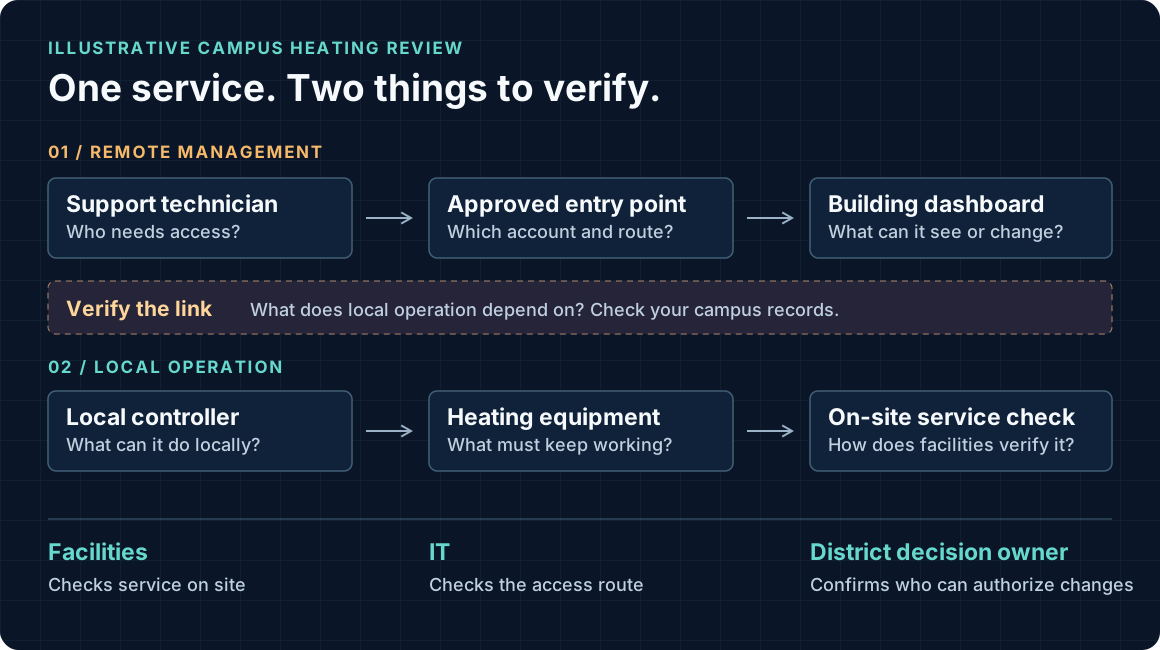
Illustrative campus heating map
- Remote management. Trace the approved support route, access controls, and dashboard.
- Local operation. Identify the controller, the equipment it runs, and the approved on-site check.
- Verify the link. Use site records to determine what local operation depends on. Facilities checks the service, IT checks access, and the district decision owner confirms who can authorize changes.
- Confirmed
- A dated, approved record supports the dependency.
- Absent
- A dated, approved record supports ruling it out.
- Unknown
- The evidence is missing, stale, or conflicting. Assign someone to check.
For example, an IT log may show that a dashboard lost contact with a controller. That answers a question about the connection. To decide whether heat is available, facilities needs its own observation, such as a reading from an approved on-site check. Keep the two observations separate in the incident record.
Rehearse the decision in 20 minutes
Use the cold-morning scenario as a discussion exercise. Say the dashboard is unavailable and IT proposes pausing one remote support route. Give the group 5 minutes to establish the facts, 10 minutes to walk through the decision, and 5 minutes to assign a follow-up.
- Facilities explains how to check the service on site and when to escalate under the district’s safety procedures.
- IT verifies which account and route are in scope, what logs it can preserve, and who has access to them.
- The district decision owner uses the district’s incident and safety procedures to identify the action, its authorizer and alternate, the backup contact route, and the evidence required before restoring access.
End by giving the most consequential unknown an owner, a due date, and a specific proof point. If the team cannot explain how local operation would be verified, for example, ask the facilities owner to obtain the approved procedure and confirm who can carry it out.