
Maintenance was underway at a Polish combined heat and power plant when its steam turbine and process-water treatment system stopped. The plant initially suspected contractor error. CERT Polska's investigation established a cyberattack. CERT follow-up, p. 5 ↗
Eleven days separated the first recorded private-APN scanning on December 18, 2025, from disruption on December 29. Between those dates were network scans, attempted logins, and connections to industrial controllers. That sequence raises two useful engineering questions: where could an unexpected interaction have become an earlier warning, and where would its evidence remain after the equipment was reset or destroyed?
Our goal is to give the responder less guesswork: a distinct interaction, enough context to investigate, and a record they can still retrieve during recovery.
01 / The opportunity
The attack had a runway.
The follow-up examines a smaller combined heat and power plant supplying heat to approximately 50,000 residents. It extends CERT Polska's initial energy-sector incident report with a reconstructed route through a distribution system operator's private APN, a cellular data network.
APN scanning began on December 18. Plant-network scans followed on December 21. On December 25, the attacker established S7 connections to three Siemens PLCs; investigators could not determine their exact purpose. Disruptive activity followed on December 29. Operators responded quickly enough to avoid interruption of customer heat or electricity supplies. CERT follow-up, pp. 5, 9-11 ↗
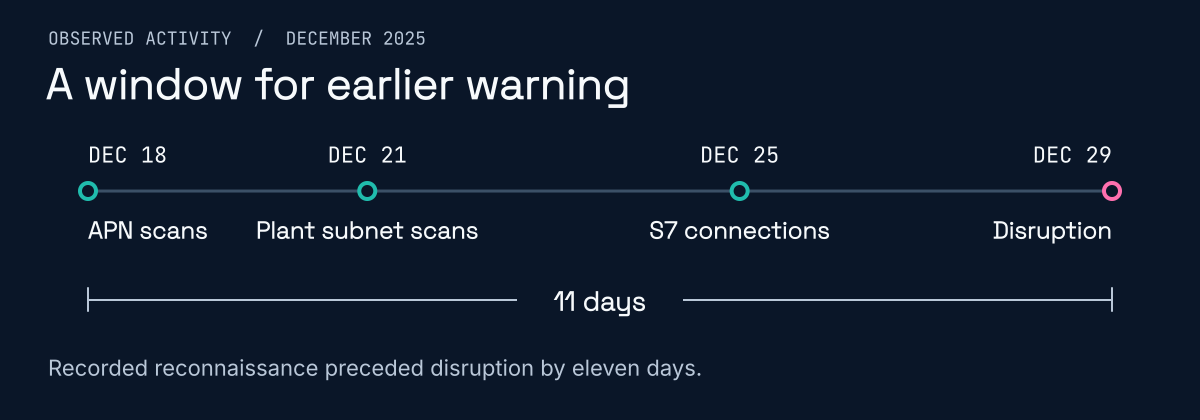
Observed activity / December 2025
Eleven days before impact.
- Private APN scans
- Plant subnet scans
- S7 connections
- Disruption
The practical opportunity sits in those intervening interactions. An approved inventory tool and an intruder can ask similar identification questions. Placement, expected activity, and the resulting session detail determine whether a responder gets a useful lead.
02 / Follow the management path
“Private” needs an enforced boundary.
The reported route began at a wind-farm FortiGate VPN and firewall, continued through a Teltonika cellular router into the private APN, and reached a WAGO controller at the CHP plant. Its web administration interface was reachable from the APN and used default credentials. Correlated logs indicated that SSH tunneling most likely provided access into the plant's OT network. CERT follow-up, pp. 7-9 ↗
The administrative interfaces matter alongside the industrial protocols. A serial connection used for the intended telecontrol function did not remove the cellular router's Ethernet management path.
At the plant, one of the first recorded activities involved unsuccessful firewall-management logins, including attempts using a username associated with a telecontrol deployment company. A familiar account name is not proof of approved access. CERT follow-up, p. 10 ↗
CERT found permissive device-to-device communication common among the Polish organizations it surveyed. That makes the APN configuration a practical engineering check. CERT recommends client isolation, tightly permitted communications, monitoring, and centralized gateway logging. Treat those as foundational controls. A decoy adds a place to observe unexpected exploration alongside existing monitoring: an isolated management persona, a synthetic engineering artifact, or a supported protocol endpoint reachable from the path being assessed. CERT findings and recommendations, pp. 16-17 ↗
03 / Preserve the record
Recovery can erase the story.
The attacker corrupted the WAGO controller's partition table; investigators recovered no valuable logs. Factory resets of the cellular router and firewall followed. At the plant, operators restored Siemens controllers to factory settings and reloaded logic backups to recover operations. Those recovery steps also deleted controller logs.
Evidence survived unevenly. The FortiGate factory reset erased its logs. Selected Teltonika events remained recoverable because RutOS versions earlier than 7.07 retained the event database through a factory reset. Those events and network records helped reconstruct the route. The lesson is to export valuable records before either destructive activity or urgent recovery removes them. CERT follow-up, pp. 8, 11, 14-15 ↗
Evidence should outlive
the device that recorded it.
A decoy can record the source, time, requested operation, and simulated result. A separately protected collector can retain exported records if that decoy is later lost. Separate credentials, restricted administration, and an independently monitored delivery path give that separation substance.
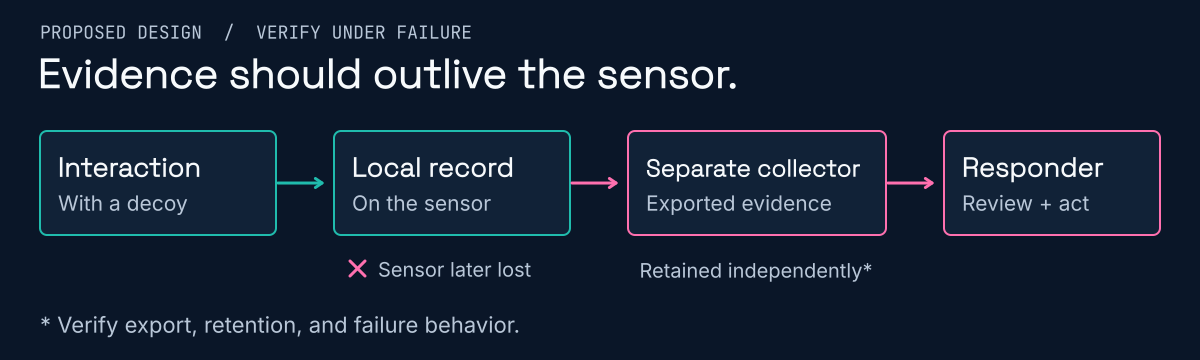
Proposed design / Verify under failure
Evidence should outlive the sensor.
- InteractionWith a decoy
- Local recordOn the sensor
- Separate collectorExported evidence, retained independently
- ResponderReview and act
Test that exported records remain available when the sensor is lost.
04 / Place for a decision
Give reconnaissance somewhere useful to land.
Start with one question: would unexpected access through this maintenance or interconnection path reach our response team? Choose a decoy that fits the workflow. Keep its identity and data synthetic, its state disconnected from real process I/O, and its network permissions explicit.
CISA's decoy guidance supports this approach to placement, monitoring, and response. Its water-sector example includes IT systems holding OT configuration information and backups. Valuable detection opportunities extend beyond controller emulation. CISA decoy guidance ↗
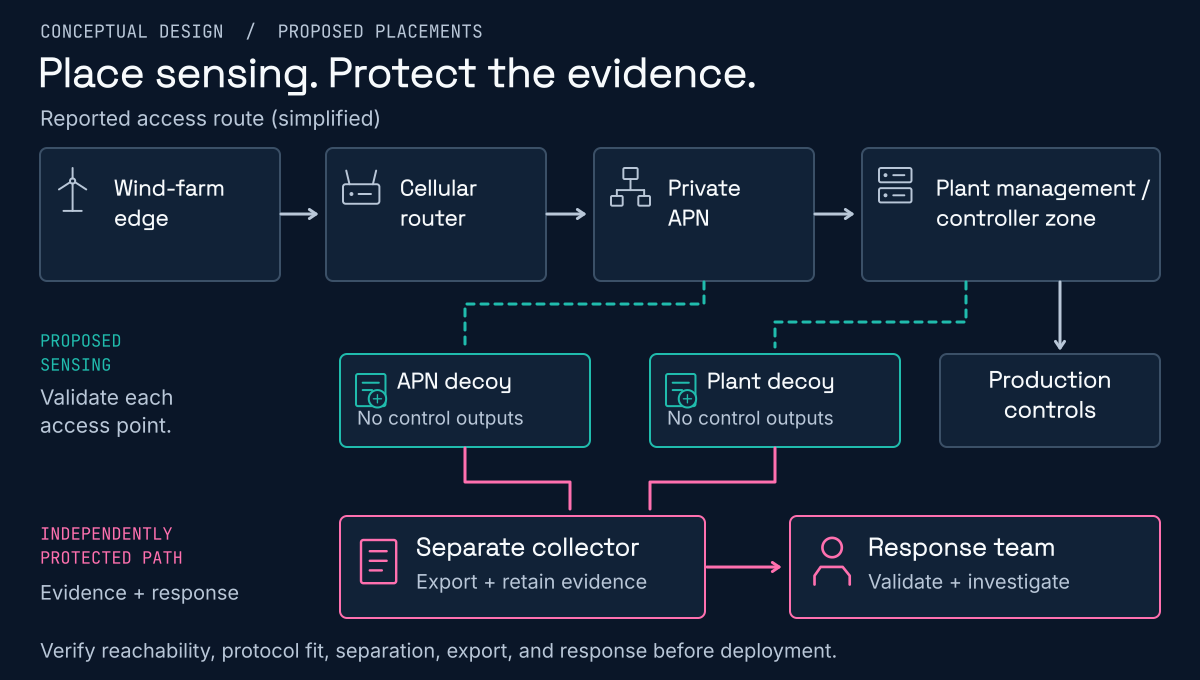
Conceptual design / Proposed placements
Place sensing. Protect the evidence.
Reported access route, simplified
- Wind-farm edge
- Cellular router
- Private APN
- Plant management / controller zone
Proposed sensing branch
Isolated APN or plant decoy
No control outputs
Separate collector
Export and retain evidence
Response team
Validate and investigate
05 / First-party research
From a connection to a useful record.
Our retained research shows the kind of detail a decoy can supply. These examples answer different questions: what a client requested, whether a tested service recovered, and whether submitted instructions repeated across interfaces.
Five events. A readable S7 sequence.
What was recorded
Transport negotiation, communication setup, then three identification reads with deterministic replies. The retained timestamps span 413 milliseconds.
- 01
COTP connect - 02
Setup communication - 03
Read SZL 0x0011 - 04
Read SZL 0x0011 - 05
Read SZL 0x001c
Why it matters
The record distinguishes identification from a request to change process state, giving an analyst something specific to compare with approved activity.
Reconstructed from verified telemetry. Identification only; the event span is not a network-latency benchmark.
DNP3, before and after reboot.
What was recorded
Independent byte review verified group-110 replies before and after a controlled reboot of the host running a research block-valve RTU persona, including CRCs, addressing, and all four bounded description strings.
Why it matters
This checks the actual protocol reply after recovery, beyond a green service indicator.
The test used a pipeline-oriented research profile. Off-host evidence preservation under sensor loss is a separate acceptance test.
One pattern across multiple interfaces.
What was recorded
Twenty-four SSH sessions carried the same ordered 16 submitted fragments across several emulated management interfaces, including UPS management.
Why it matters
Repeated instructions offer a concrete starting point for comparison and hunting. Read After the Login ↗
Submitted fragments and simulated replies do not prove execution or transfer.
06 / Prove the complete path
Commission it under failure.
Use the video controls to play the silent, 20-second animation.
Download animationRead the animation sequence
- An authorized test interaction reaches the isolated decoy. Its activity indicator lights up.
- The event is exported to a separate collector; the stored record remains highlighted.
- The alert reaches the responder's phone. The phone lights and vibrates to indicate notification.
- The test sensor is taken offline after collector receipt. The separate record stays available for investigation.
This illustrates the acceptance test, not a replay of the Polish incident. The retained record must be retrieved and the response path verified in the selected deployment.
A useful lab session produces receipts, not just a convincing screen. Agree the selected build, protocol, placement, retention, and responder before testing. Then exercise four conditions:
- 01
Make the interaction.
Generate a safe, authorized request. Match its timestamp and event identity at the sensor, separate collector, and responder's destination. Confirm acknowledgement.
- 02
Interrupt delivery.
Disconnect the collector route. Check bounded buffering, queue limits, and visible failure status. Reconnect and reconcile retained event IDs, including duplicates or loss.
- 03
Lose the disposable sensor.
Remove or stop the lab instance after confirmed export. Verify the collector still holds the earlier record and that independently monitored sensor disappearance reaches the agreed response route.
- 04
Rehearse the decision.
Give the responder the evidence. Verify the first investigation step, operations escalation, and backup coverage. Include maintenance and approved scanning in the test cases.
For disconnected sites, the collector and response workflow can be local. A second destination still needs scrutiny if it shares the same power, network, credentials, or administrator. Define the failures the design must withstand, then measure them.
What Deception Check brings
Deception Check provides instrumented industrial and management personas with synthetic state and structured interaction records. From the first touch through follow-on requests, those records show what a visitor tried and how the decoy responded. Integrate that evidence with existing monitoring and response workflows so the team can investigate in the tools it already uses.
One useful detection question
Commission one path with us.
Bring a representative energy or industrial architecture. We will help select a supported decoy profile, define the containment boundary, and scope a lab test from interaction through evidence preservation to response.
Plan a technical session Download the power-sector whitepaper (PDF)A practical starting point: an architecture sketch, acceptance evidence, and a named support handoff.