RESPONSE NOTES / CVE-2026-114625
Read-only access.
Operator privileges.
An actively exploited VeloCloud Orchestrator flaw breaks the boundary between a tenant account and privileged management functions. Check the build, then check what changed.
Read-only should mean someone can look without changing things. CVE-2026-114625 turns that assumption into a problem for the system managing your network.
Arista disclosed active exploitation on October 22. A valid VeloCloud Orchestrator portal session, with as little as the Enterprise Read Only role, is enough to reach the vulnerable functionality. SQL injection can elevate the attacker to operator privileges and let them impersonate a local superuser operator.
That makes this an access review as well as a patching task. Which accounts can reach the console? What privileged actions happened? Can someone outside that console verify the answers?
Reachable web interface plus a valid portal session.
CVSS v3.1. The vendor also assigns 9.4 under v4.0.
CISA's listed remediation deadline for covered federal agencies; forensic triage is flagged.
Source: Arista's CNA record and the official CISA KEV feed, which added the flaw October 23. Other organizations should prioritize the vendor's remediation guidance given confirmed exploitation.
The account role is not the final boundary
VeloCloud Orchestrator is the management system for an SD-WAN deployment. Its administrative authority makes a low-privilege login valuable if an application flaw can cross that role boundary. Read-only accounts still deserve an owner, a reason to exist, and controlled network access.
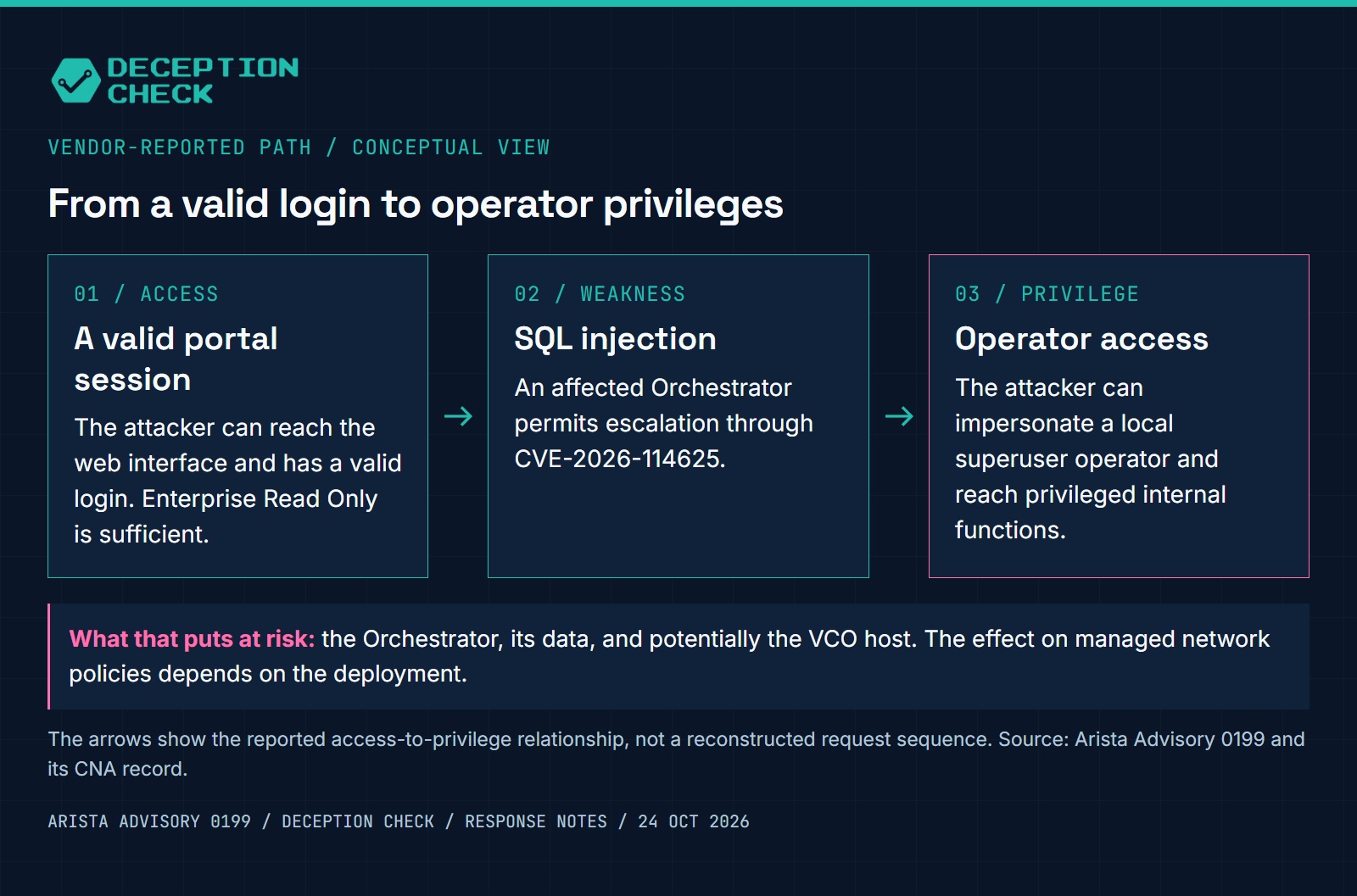
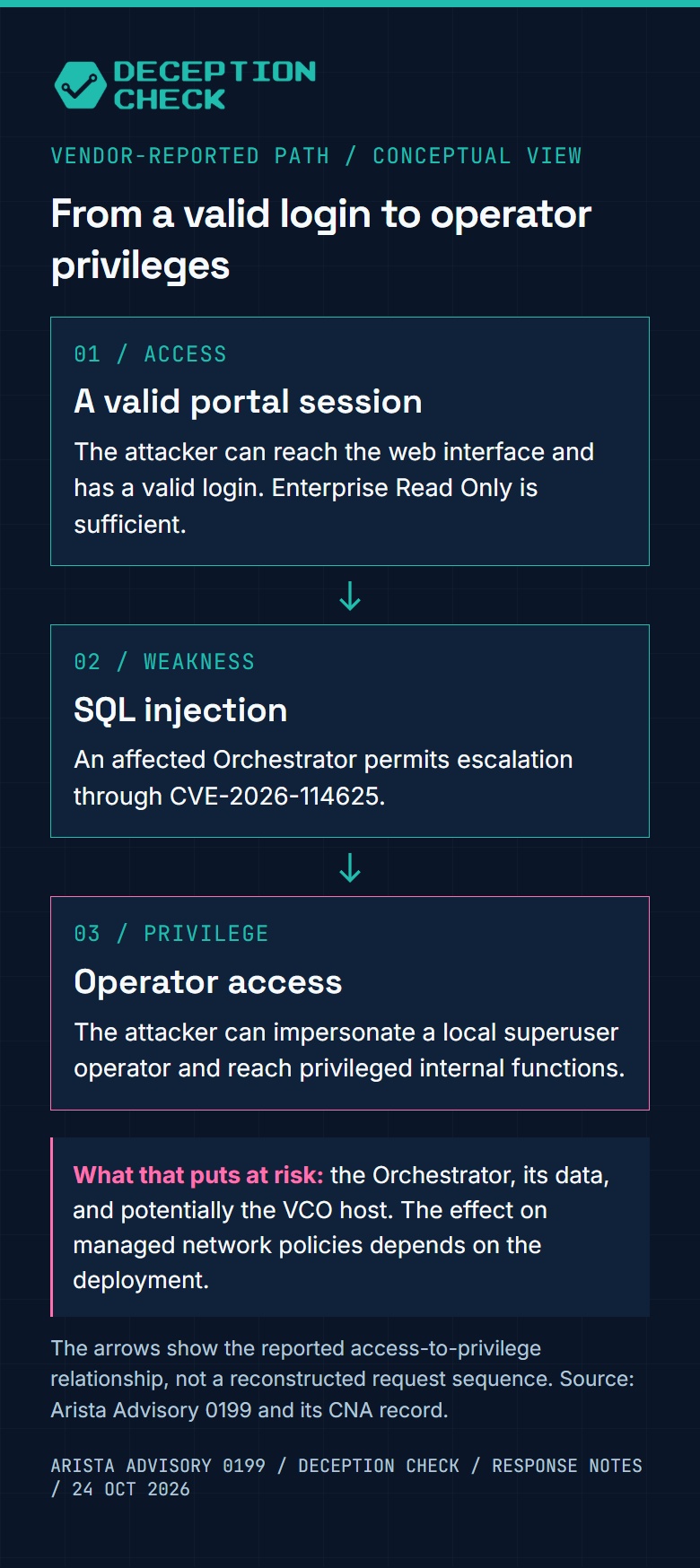
VENDOR-REPORTED PATH / CONCEPTUAL VIEW
From a valid login to operator privileges
The attacker can reach the web interface and has a valid login. Enterprise Read Only is sufficient.
An affected Orchestrator permits escalation through CVE-2026-114625.
The attacker can impersonate a local superuser operator and reach privileged internal functions.
What that puts at risk: the Orchestrator, its data, and potentially the VCO host. The effect on managed network policies depends on the deployment.
The arrows show the reported access-to-privilege relationship, not a reconstructed request sequence. Source: Arista Advisory 0199 and its CNA record.
Download the landscape diagram or the mobile diagram. The flow above is also the text equivalent.
VeloCloud Edge and Gateway are not affected by this vulnerability. For a deployment connecting plants, utilities, or other operational sites, investigate which routing and segmentation policies the compromised management role could change. The relevant question is the authority granted by your network design, rather than the industry label on the appliance.
Check the running build, not the last patch ticket
For on-premises Orchestrators, Arista lists three affected release trains and the following fixes. Its hosted and Dedicated Orchestrators were affected and have already been patched.
| Release train | Affected builds | Fixed build |
|---|---|---|
| 5.2 | Before 5.2.3.18 | 5.2.3.18 or later in 5.2 |
| 6.1 | Before 6.1.3.10 | 6.1.3.10 or later in 6.1 |
| 6.4 | Before 6.4.2.12 | 6.4.2.12 or later in 6.4 |
September's CVE-2026-93952 advisory named fixes including 5.2.3.16 and 6.4.2.8. Systems still running those builds are below the new cutoffs. Closing the September ticket does not establish that this flaw is fixed.
End-of-support releases were not assessed. Check those with Arista TAC rather than treating an omitted version as a clean bill of health.
Patch the software. Account for the activity.
Restrict the web interface to trusted administrative networks while applying a fixed release. A reachable service is not automatically internet-facing, so verify the actual paths to it, including broad internal networks and third-party administration.
- Preserve the records you will need. Where feasible, collect web access, backend application, system, and database logs, plus relevant filesystem timestamps, before remediation. Retain a copy under separate access controls so the management system is not the only place answering questions about itself.
- Review privileged changes against approvals. Compare recent operator and administrator activity with approved work. Resolve unexpected accounts, role changes, and configuration changes with the relevant owner. Capture the actor, time, object changed, and before-and-after values where your telemetry provides them.
- Look across the host and network. Arista recommends checking unusual web requests, unexpected outbound activity, backdoor daemons, and webshells. Correlate these records with access and change history. A login, a request, and a confirmed unauthorized change are different pieces of evidence.
- Verify the result from a trusted vantage point. Record the running fixed build and the exposure controls actually in place. Check whether managed policies still match the intended configuration. If evidence is missing or a change remains unexplained, assign the follow-up before declaring the incident closed.
Two useful leads from Arista
Research data from Shodan adds network, GeoIP, and service context to Arista's two published source addresses. Its service observations below are dated October 21, 2026.
| Source IP | Network and location context | Observed service | Use in the investigation |
|---|---|---|---|
74.82.197.86 | AS21887 Shodan organization: Cluster Logic Inc Shodan ISP: Fiber Logic Inc. GeoIP: Tokyo, Japan | 22/TCP: SSH OpenSSH 8.9p1 Last seen: October 21 | Search VCO access records for the address, then correlate the account, requests, and changes. Shodan also records the hostname 74.82.197.86.16clouds.com as a passive enrichment lead. |
38.54.50.151 | AS154177 Shodan organization: Cogent Communications, LLC Shodan ISP: LIGHT NODE LIMITED GeoIP: Tokyo, Japan | 22/TCP: SSH OpenSSH 9.6p1 Last seen: October 21 | Search the same VCO records and review the account and actions involved. Retain the observation date when comparing this address with other infrastructure records. |
Shodan's organization and ISP fields are reported separately. GeoIP describes the recorded infrastructure location; it does not identify the attacker. An SSH observation is not evidence of a VeloCloud service or of exploitation.
Arista recommends blocking these addresses and reviewing logs. A match is an investigation lead, not proof of compromise; an empty search does not cover other infrastructure. Keep behavioral review and the build check in the same response.
Make the closeout useful to the next responder
01 / FIXED
What is running now?
Record the release train, running build, upgrade time, allowed management networks, and person who verified them.
02 / INVESTIGATED
What happened before that?
Record the period reviewed, evidence retained, changes explained, remaining gaps, and the owner of the next action.
The point of a strong role boundary is to limit what a valid account can do. When that boundary fails, the response needs both a software fix and a defensible account of what the new privileges were used for.
TAKE IT TO THE RESPONSE CALL
A six-card response brief
Share the build checks, access path, indicators, and closeout questions with the team doing the work.
Download the carousel PDFRead the accessible textWant help testing the handoff from a suspicious interaction to an owned response? Talk with Deception Check about a scoped pilot.
Sources and scope
This is an analysis of public advisories, not a Deception Check fleet observation. Vulnerability facts and patch guidance come from Arista; the investigation and closeout structure are our recommendations. Source status was checked October 24, 2026.
- Arista Security Advisory 0199: active exploitation, prerequisites, impact, versions, indicators, and response guidance.
- Arista's CVE-2026-114625 CNA record: vulnerability classification, affected ranges, and CVSS scores.
- CISA's official KEV data: October 23 addition, October 26 due date, and forensic-triage flag.
- Arista Security Advisory 0183: the distinct September vulnerability and its earlier fixes.