
RESPONSE NOTES / VIRTUALIZATION AND EDGE SECURITY / OCTOBER 29, 2026
Some VMware admin actions could go unlogged.
What would your team check if the host audit trail missed an action? Two newly listed exploited flaws show why patching, privileged-access review, and evidence collection belong in the same response.
A low score can still leave a responder with a problem
A hypervisor is the software that runs virtual machines. Its audit log is part of the record of who changed what. In CVE-2026-41709, an administrator can perform certain VMware ESX operations without those operations being logged. Administrator access is a prerequisite, which helps explain its low severity score of 2.7 under the Common Vulnerability Scoring System (CVSS).
CrowdStrike reports that WARP PANDA exploited the ESXi command-logging bypass as a zero-day during intrusions involving VMware vCenter environments. vCenter manages virtual infrastructure; ESX is the affected host component. The flaw can leave gaps in the activity record, rather than demonstrating that an attacker switched off every log.
CISA added it to its Known Exploited Vulnerabilities (KEV) catalog on October 28, confirming known exploitation. For teams running affected hosts, the useful response goes beyond moving a low-scoring ticket up the patch queue: review privileged access and check what evidence reaches a collector the host's administrators cannot simply rewrite.
Three checks worth assigning today
Prove the update is running
Match each host to the vendor's supported fix. Record the installed build and the active host or kernel version after maintenance.
Review the access that matters
Check administrator accounts, remote management, authentication, and recent changes. Limit exposed management access through approved paths.
Test the second record
Generate an approved harmless test event. Verify its arrival, retention, alert routing, and the named person who responds when collection fails.
A second copy of the same host log helps retention, but cannot restore an event the host never generated. Pair it with a different source: identity-provider activity, vCenter tasks, management-network flows, or another independently collected interaction.
TWO SEPARATE REPORTED CASES / SIMPLIFIED PATHS
VMware ESX: a gap after admin access
- 01 / PRIVILEGED ACCESSThe intruder already has administrator access
The logging weakness is not an initial break-in method.
- 02 / ACTIVITYCertain ESX operations can go unlogged
The vendor does not publicly list the omitted operations.
- 03 / INVESTIGATIONThe host record can be incomplete
Check identity, management-plane, and network records alongside it.
PAN-OS: a separate route from web access to root
- 01 / EXPOSED MANAGEMENTPHP2Shell reaches a vulnerable web service
Vendor guidance scopes affected PAN-OS management interfaces.
- 02 / LOCAL ESCALATIONFragnesia raises access to root
The kernel flaw is used after code is running on the device.
- 03 / FOLLOW-ON ACCESSCredential and directory activity follows
Review connected identity systems as well as the firewall.
A separate Linux chain belongs in the exposure review
Dream and Unit 42 describe PHP2Shell chained with Fragnesia, CVE-2026-46300, against vulnerable PAN-OS systems. PHP2Shell supplies the remote code-execution step; Fragnesia supplies local escalation to root, the highest operating-system privilege. Investigators report credential extraction and directory enumeration after the devices were rooted.
This is separate from CrowdStrike's ESX case. Fragnesia was publicly disclosed in May; its October 28 KEV entry brings renewed urgency to an existing kernel issue. Use Unit 42 and the linked PAN-OS advisory for affected management interfaces, exact supported releases, and incident-response guidance. The PAN-OS advisory limits the affected surface to management HTTPS web UI and XML API access. It says GlobalProtect portal, gateway, and Clientless VPN services are not impacted. Remove public management exposure and restrict management access to trusted sources.
For ordinary Linux hosts, use the distribution's supported kernel fix and confirm the running kernel or applicable livepatch state. For appliances, use the appliance vendor's guidance. Installing an endpoint agent or replacing its kernel independently is not an appropriate workaround.
The technical steps below explain what the access made possible and where defenders can collect evidence. Dream's recovered chain targets the original PHP2Shell pair, including the session-state path documented for CVE-2026-109619. That is distinct from the separate CVE-2026-115560 advisory.
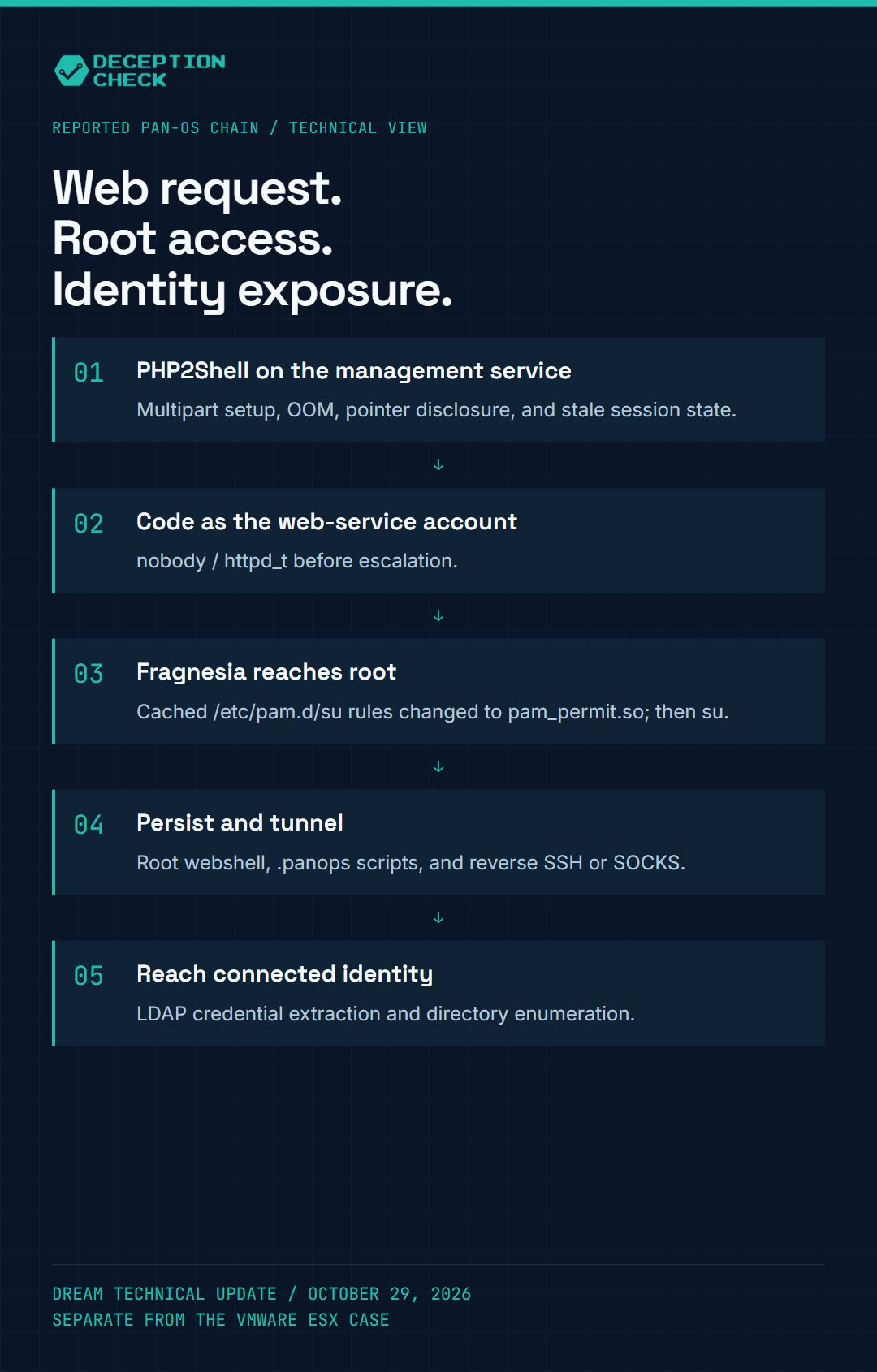
REPORTED PAN-OS CHAIN / TECHNICAL VIEW
From a management request to privileged follow-on access
- 01MANAGEMENT WEB SERVICE
Reach vulnerable PHP request handling
Dream describes multipart requests, memory exhaustion, pointer disclosure, and stale session state in
appweb. The original PHP2Shell pair isCVE-2026-109618 / 109619.Keep Management HTTPS access, request timing, PHP or web-worker errors, and vendor support evidence. - 02INITIAL EXECUTION
Run code as the web-service account
The recovered chain executes as the lower-privilege web-service account,
nobody, in thehttpd_tSELinux security-policy domain before the privilege-escalation step.Linux analogue D4 Web-worker ancestry, shell children, temporary executables, and outbound connections. - 03LOCAL KERNEL ESCALATION
Change cached authentication rules, then become root
Fragnesia changes page-cache-backed
/etc/pam.d/sucontent to usepam_permit.so. The reported chain then usessuto obtain root.Linux analogue D5 Root-account child below a web worker; independently establish any non-root-to-root transition. Ordinary file-write telemetry may miss the cached-content change. - 04PERSISTENCE AND ACCESS
Keep a webshell and a route back in
Reported artifacts include
/unauth/php/change_password.php, scripts under/usr/local/lib/.panops/, systemd orrc.localpersistence, and reverse SSH or SOCKS access.Linux analogue D6 Direct web-worker SSH child and forwarding request; correlate with network sessions and vendor-supported artifact collection. - 05CONNECTED IDENTITY
Extract a directory-service credential and enumerate the directory
Recovered artifacts support LDAP directory-service credential extraction and user/group enumeration after access to an internal management server.
Investigate Service-account authentication, directory queries, source systems, scope, and credential rotation.
What is happening inside the kernel?
The Linux CNA describes a missing shared-fragment marker during network-buffer coalescing. An ESP/IPsec path can then skip copy-on-write, the protection that normally prevents shared cached data from being modified in place, and change page-cache-backed content. In the reported campaign, that mechanism changed the authentication policy read by su. The useful observable consequence is an unexpected privileged process and its surrounding activity, not necessarily an ordinary write to the file on disk.
Download the technical chain diagram. Use vendor-supported forensic collection for the appliance. On supported Linux endpoints, the detections below examine process ancestry, privilege, and tunnel requests.
For operations and business leaders: Neither reviewed campaign establishes an attack on a plant. The relevance to operational environments is where these systems sit: hosts can run operational applications, and firewalls control access between networks. Ask the service owner what depends on the affected system and how containment can be carried out safely.
Match VMware's fix to the right product
Broadcom published the advisory and fixes on July 29. The October KEV listing is new evidence of exploitation, not the first availability of a patch.
| Product branch | Vendor-listed fix for CVE-2026-41709 | Closeout evidence |
|---|---|---|
| ESX 8.0 | ESXi80U3j-25429389 | Host reports the supported fixed build. |
| ESX 9.0 / VCF or VVF | ESXi-9.0.2.0100-25595025 | Component and bundle match the supported release. |
| ESX 9.1 / VCF or VVF | ESXi-9.1.0.0-25370933 | Component and bundle match the supported release. |
| Cloud Foundation 5.x | 5.2.4 | Follow the vendor's component and async-patching guidance. |
| Telco Cloud Platform 5.0.x / 5.1.x | Broadcom KB 449886, CVE-2026-41709 row | Follow the supported platform compatibility path. |
Source: Broadcom section 3e, not the advisory's combined table of other flaws. Use the current vendor matrix for later releases and unlisted support branches. No workaround is listed for this issue.
CISA's federal remediation dates are November 11 for the ESX flaw and October 31 for Fragnesia. Those deadlines apply to covered federal agencies; other organizations should prioritize by exposure and operational dependency.
What our own decoys add: compare the instruction with the artifact
Our retained October SSH records provide a small, concrete example of why evidence layers matter. We checked a submitted key-placement instruction against a matching virtual-file capture in the same session. The content hashes matched. One record described the requested action; the other preserved the corresponding decoy artifact.
FIRST-PARTY RECORDS / SSH DECOY / OCTOBER 1, 2026
One instruction. Two records to compare.
Instruction recorded
The session submitted an instruction to place a public key in the account's authorized_keys file.
SOURCE: COMMAND INPUT
content hash
Decoy file captured
The capture record in the same session carried the matching key-line content hash.
SOURCE: VIRTUAL-FILE CAPTURE
How we checked that the two records matched
The retained input event is cowrie.command.input; the corresponding virtual-file capture is cowrie.session.file_download. We joined the same decoy and session, decoded the complete submitted public key, and recomputed SHA-256 over the key line including its terminating line-feed byte. That digest matched the capture record's shasum field.
same source + same session
SHA256(retained public-key line + LF) == capture.shasum
Key bytes and source/session identifiers are withheld. The displayed timestamps come from the retained records.
The useful habit is to keep those layers separate. A command log answers what was submitted. A captured artifact answers what was retained. An authentication record is needed to answer whether that key was later accepted. The SSH research note explains the wider method.
A decoy can add an independent signal when someone interacts with it and its collection path is working. Place it where legitimate use is understood, keep collection and administrative access separate, and test the alert path. It complements platform updates and ordinary monitoring.
Research detection appendix: six checks, with the logic exposed
Start with the data you actually collect. The pack covers suspicious Linux process behavior, logging interference, logging configuration, missing collection signals, root-account process behavior, and SSH tunnel requests. It contains standard-source Sigma rules, native platform hunts, response steps, false positives, a separate collection-health design, and a validation record.
Validation boundary: Detection logic is tested with safe fixtures and independently reviewed. Choose the documented telemetry route, set its source selector, and test it against your own records before enabling alerts. These are behavior and evidence-health checks, not a signature for the undisclosed ESX operation or proof that a clean search clears a host.
Fragnesia can alter page-cache-backed content without an ordinary file-write event. A file watcher or unchanged on-disk hash is therefore not enough to dismiss suspected exploitation.
Start with the logs you already collect. The Linux Sigma rules use standard process-creation sources and familiar fields. Native queries name their actual product tables or event formats. The collection-health check is an engineering design, separate from event rules.
Use a route after its source guide and a known event confirm collection, required fields, and account or parent-process meaning.
Read the full rule and platform library / Choose a source and get started / See exactly what was tested.
| Check | Starting point | What you need |
|---|---|---|
| D1 | Native ESXi shell-log hunts | Imported ESXi shell events |
| D2 | Standard Linux Sigma | Linux process events; imported ESXi companion for D2 |
| D3 | Monitor design | Engineering design only |
| D4 | Standard Linux Sigma | Linux direct-parent process behavior |
| D5 | Standard Linux Sigma | Linux direct-parent process behavior |
| D6 | Standard Linux Sigma | Linux direct-parent process behavior |
D1 / ESXi syslog configuration command observed
Data: Imported ESXi shell events
What it checks: A direct captured command starts with esxcli system syslog config set; inspect the configuration result and authorization.
Required fields: See ESXi source guide
Expected false positives: Approved collector migration, certificate or retention tuning, recovery.
Coverage limits: API configuration changes, compound shell commands, encoded commands, omitted shell records, aliases, and alternate tools. A matched command may fail. A set command alone does not prove logging was disabled.
Response: Preserve remote logs; compare current log destinations and retention to signed baseline through management inventory, inspect the change ticket and account, and check D3. Do not run the matched command.
Use the native ESXi log hunts below. This source is not relabeled as Linux endpoint telemetry.
CrowdStrike
Imported ESXi shell logs
Documented VMware parser or Broadcom shell[world-id]: layout; actual source selector
D1-esxi.cqlSetup and coverage guideSplunk
Imported ESXi shell logs
Documented VMware parser or Broadcom shell[world-id]: layout; actual source selector
D1-esxi.splSetup and coverage guideSumo Logic
Imported ESXi shell logs
Documented VMware parser or Broadcom shell[world-id]: layout; actual source selector
D1-esxi.sumoSetup and coverage guideD2 / Explicit log-file deletion or truncation command
Data: Linux process events; imported ESXi companion for D2
What it checks: Linux event hunts require a real rm/truncate/shred process Image plus a direct-start command naming an explicit log path. The ESXi companion instead parses a logged shell command; it has no Linux process Image event.
Required fields: See documented source fields in the linked guide; Sigma detection uses only Image, ParentImage, CommandLine, User.
Expected false positives: Log rotation, space recovery, support collection cleanup. Prefer narrow approved executable/hash, path, account, and ticket exceptions with expiry.
Coverage limits: Shell redirection, unlink/truncate syscalls inside another process, wildcards relative to working directory, path variables, quoted tool names, encoded commands, API actions, or records never emitted. Successful page-cache writes need not produce a file-write event.
Response: Preserve existing remote copies and volatile evidence; inspect command result, filesystem state, audit coverage, retention jobs, and recent admin sessions. Avoid restarting or overwriting evidence before triage.
SIGMA / lnx_explicit_log_removal.yml
title: Linux explicit log removal command
id: 965ed3c2-048f-46a7-bc0d-720c29352572
status: experimental
description: >-
    An observed rm, truncate, or shred process command names a supported explicit log path.
    It is a command attempt, not proof that a log was erased.
author: Deception Check
date: '2026-10-29'
logsource:
    category: process_creation
    product: linux
detection:
    selection:
        Image|exists: true
        Image|re: '/(rm|truncate|shred)$'
        CommandLine|re: '^(?:/[^\s]+/)?(?:rm|truncate|shred)\s+[^\n]*(?:/var/(?:run/)?log/|/scratch/log/)'
    condition: selection
falsepositives:
    - >-
        Authorized rotation, disk recovery, and support cleanup.
level: medium
fields:
    - Image
    - ParentImage
    - CommandLine
    - User
    - ProcessGuid
    - ParentProcessGuid
Microsoft Defender XDR
Linux EDR process creation
D2.kqlSetup and coverage guideCrowdStrike
Linux EDR process creation
D2.cqlSetup and coverage guideSplunk
Sysmon for Linux XML process events
D2.splSetup and coverage guideSumo Logic
Sysmon for Linux XML process events
D2.sumoSetup and coverage guideSophos
Current Linux processes snapshot
D2-snapshot.sqlSetup and coverage guideCrowdStrike
Imported ESXi shell logs
Documented VMware parser or Broadcom shell[world-id]: layout
D2-ESXi-esxi.cqlSetup and coverage guideSplunk
Imported ESXi shell logs
Documented VMware parser or Broadcom shell[world-id]: layout
D2-ESXi-esxi.splSetup and coverage guideSumo Logic
Imported ESXi shell logs
Documented VMware parser or Broadcom shell[world-id]: layout
D2-ESXi-esxi.sumoSetup and coverage guideD3 / Detect expected-log loss with an independent monitor
Data: Engineering design only
What it checks: Engineering workflow over authoritative inventory and independent health evidence; not an ordinary Sigma absence rule.
Required fields: Choose real expected-inventory and independent-health inputs in the design
Expected false positives: Network outage, collector routing or parser changes, stale inventory, maintenance, overloaded ingestion, clock errors.
Coverage limits: Design only; no stock table, ordinary Sigma rule, native query, or deployed monitor is supplied. Missing records require authoritative expected inventory. Healthy markers cannot prove every operation was logged.
Response: Check pipeline delay and queue/drop metrics, maintenance, remote collector receipts, current forwarding config, and independent vCenter/identity/network records. Escalate unexplained loss; preserve existing evidence. A second deadman check must alert if the monitor itself stops publishing.
This is a stateful monitoring workflow, not an ordinary Sigma event rule.
D4 / Linux web worker launches a shell or executable from temporary storage
Data: Linux direct-parent process behavior
What it checks: Direct parent basename is apache2, httpd, nginx, php-fpm with optional numeric version, or php-cgi; child basename is a shell or child image path begins /tmp/, /var/tmp/, or /dev/shm/. Count one distinct process start; 15-minute review window.
Required fields: See documented source fields in the linked guide; Sigma detection uses only Image, ParentImage, CommandLine, User.
Expected false positives: CGI scripts, application shell helpers, image conversion or job runners. Baseline exact approved path, hash, service and application, rather than allowing all shell children.
Coverage limits: In-process PHP code, webshells that do not spawn a process, renamed web workers, deeper ancestry, dropped telemetry, containers with partial host coverage. This is not a PHP2Shell signature.
Response: Inspect full ancestry, service identity, requested URL and application logs, executable provenance, outbound connections, and persistence. Isolate through approved incident procedures if corroborated.
SIGMA / lnx_web_worker_shell.yml
title: Linux web worker launches a shell
id: f83d47f4-cc3d-4ded-90cc-42916b79300c
status: experimental
description: >-
    A direct web-worker child is a shell. Review application behavior before treating this
    as compromise.
author: Deception Check
date: '2026-10-29'
logsource:
    category: process_creation
    product: linux
detection:
    selection:
        Image|exists: true
        ParentImage|re: '/(apache2|httpd|nginx|php-fpm(?:[0-9.]+)?|php-cgi)$'
        Image|re: '/(sh|bash|dash|ash|zsh|ksh)$'
    condition: selection
falsepositives:
    - >-
        Approved CGI applications and application shell helpers.
level: medium
fields:
    - Image
    - ParentImage
    - CommandLine
    - User
    - ProcessGuid
    - ParentProcessGuid
SIGMA / lnx_web_worker_temp_exec.yml
title: Linux web worker starts a temporary executable
id: ecfd817a-82a7-4438-85da-348ba2e57b20
status: experimental
description: >-
    A direct web-worker child executes an image below temporary storage. It does not inspect
    a PHP request or identify an exploit.
author: Deception Check
date: '2026-10-29'
logsource:
    category: process_creation
    product: linux
detection:
    selection:
        Image|exists: true
        ParentImage|re: '/(apache2|httpd|nginx|php-fpm(?:[0-9.]+)?|php-cgi)$'
        Image|re: '^/(tmp|var/tmp|dev/shm)/'
    condition: selection
falsepositives:
    - >-
        Approved job runners, temporary application helpers, and deployment tooling.
level: medium
fields:
    - Image
    - ParentImage
    - CommandLine
    - User
    - ProcessGuid
    - ParentProcessGuid
Microsoft Defender XDR
Linux EDR process creation
D4A.kqlD4B.kqlSetup and coverage guideCrowdStrike
Linux EDR process creation
D4A.cqlD4B.cqlSetup and coverage guideSplunk
Sysmon for Linux XML process events
D4A.splD4B.splSetup and coverage guideSumo Logic
Sysmon for Linux XML process events
D4A.sumoD4B.sumoSetup and coverage guideSophos
Current Linux processes snapshot
D4A-snapshot.sqlD4B-snapshot.sqlSetup and coverage guideD5 / Root-account process below a web worker
Data: Linux direct-parent process behavior
What it checks: Direct web-worker child is recorded as root; parent identity and a privilege transition are not established.
Required fields: See documented source fields in the linked guide; Sigma detection uses only Image, ParentImage, CommandLine, User.
Expected false positives: Approved sudo/setuid application helper or privileged application architecture. Root master spawning a non-root worker is the opposite direction and must not match.
Coverage limits: Root account does not prove non-root parent, privilege transition, kernel exploitation, or host root inside a user namespace. Legitimate root web-service masters may match.
Response: Verify host versus container/user-namespace identity, legitimacy of privilege helpers, kernel inventory and booted vendor patch, process memory/ancestry, and application evidence. Treat PID reuse as a correlation defect.
SIGMA / lnx_root_account_web_child.yml
title: Linux root-account process below a web worker
id: c5ec43d3-ae65-497a-bc13-e03610cce2a3
status: experimental
description: >-
    A direct web-worker child is recorded under the root account. Parent identity is not available
    in this rule, so it does not prove a non-root-to-root transition or host-kernel privilege
    escalation.
author: Deception Check
date: '2026-10-29'
logsource:
    category: process_creation
    product: linux
detection:
    selection:
        Image|exists: true
        Image|re: '.+'
        ParentImage|re: '/(apache2|httpd|nginx|php-fpm(?:[0-9.]+)?|php-cgi)$'
        User|re: '^root$'
    condition: selection
falsepositives:
    - >-
        Root web-service masters, approved privileged helpers, and application startup tasks.
level: medium
fields:
    - Image
    - ParentImage
    - CommandLine
    - User
    - ProcessGuid
    - ParentProcessGuid
Microsoft Defender XDR
Linux EDR process creation
D5.kqlSetup and coverage guideCrowdStrike
Linux EDR process creation
D5.cqlSetup and coverage guideSplunk
Sysmon for Linux XML process events
D5.splSetup and coverage guideSumo Logic
Sysmon for Linux XML process events
D5.sumoSetup and coverage guideSophos
Current Linux processes snapshot
D5-snapshot.sqlSetup and coverage guideD6 / SSH remote forwarding requested below a web worker
Data: Linux direct-parent process behavior
What it checks: Direct web-worker child requests SSH remote forwarding; no deeper ancestry or established-tunnel claim.
Required fields: See documented source fields in the linked guide; Sigma detection uses only Image, ParentImage, CommandLine, User.
Expected false positives: Explicit application support tunnel or remote maintenance integration. Require a documented destination, account, owner, and expiry for exceptions.
Coverage limits: SSH configuration-file RemoteForward, command obfuscation, renamed SSH, other tunnel software, deeper ancestry, shell-string options outside captured argv. -r is different and must not match. The lexical pattern can match option-like text in a remote command; verify SSH argument position. Spelling/case variants may be missed.
Response: Inspect process ancestry and destination/session evidence, validate the business owner, contain unapproved access, and review identity use reachable through the tunnel. Do not infer success from the option alone.
SIGMA / lnx_web_worker_ssh_remote_forward.yml
title: Linux web worker requests SSH remote forwarding
id: acac19cb-6fd6-4e5c-b036-72e2b860151d
status: experimental
description: >-
    A direct web-worker child runs ssh with an explicit remote-forwarding argument. This is
    a request, not proof of an established tunnel.
author: Deception Check
date: '2026-10-29'
logsource:
    category: process_creation
    product: linux
detection:
    selection:
        Image|exists: true
        ParentImage|re: '/(apache2|httpd|nginx|php-fpm(?:[0-9.]+)?|php-cgi)$'
        Image|re: '/ssh$'
        CommandLine|re: '(?:^|\s)-[A-Za-z]*R(?:\s|[0-9*:\[])|(?:^|\s)-o\s*RemoteForward(?:=|\s)'
    condition: selection
falsepositives:
    - >-
        Approved application support tunnels and documented maintenance integrations.
level: medium
fields:
    - Image
    - ParentImage
    - CommandLine
    - User
    - ProcessGuid
    - ParentProcessGuid
Microsoft Defender XDR
Linux EDR process creation
D6.kqlSetup and coverage guideCrowdStrike
Linux EDR process creation
D6.cqlSetup and coverage guideSplunk
Sysmon for Linux XML process events
D6.splSetup and coverage guideSumo Logic
Sysmon for Linux XML process events
D6.sumoSetup and coverage guideSophos
Current Linux processes snapshot
D6-snapshot.sqlSetup and coverage guideWhy no YARA or packet signature? The reviewed material does not provide a validated malicious sample for a useful YARA rule. The ESX logging bypass and local Linux kernel path do not supply a defensible Snort or Suricata exploit signature. Network records remain useful corroboration.
Close the response with a receipt, not a quiet screen
Record the supported running fix, the privileged-access review, the independent evidence sources, and the result of a collection test. Give each gap an owner. Before declaring the incident contained, confirm that required records still arrive and that the response route reaches a person who can act.
Which second record would your team check first if the host audit trail was incomplete? Use the worksheet to make that answer specific before an incident.
Sources, scope, and method
Primary sources were checked on October 29, 2026. Vendor advisories establish product scope and fixes; CrowdStrike, Dream, and Unit 42 provide their own incident observations. The two reported cases are presented separately. Our static SSH diagram summarizes two retained records from October 1; raw identifiers and key material are withheld. Detection validation uses synthetic records, not exploit execution or customer-tenant tests. Check current vendor advisories before applying the guidance.
- Broadcom: VMSA-2026-0006, section 3e and response matrix
- CISA: official Known Exploited Vulnerabilities catalog data
- CrowdStrike: October 28 legal threat-landscape report
- Dream: PHP2Shell chain, updated October 29
- Unit 42: PHP2Shell threat brief, October 29 update
- Palo Alto Networks: affected management surface and supported fixes
- Canonical: Fragnesia explanation and vendor update guidance
- Linux CNA: CVE-2026-46300
- Deception Check: retained SSH key research and method